Joseph Mulhatton: The Liar Laureate of the World

Since just before last year’s vitriolic presidential election, a new phrase has entered the American political lexicon. It has become a rhetorical strategy all its own, almost like a brand new logical fallacy in that it does not hold up as an argument under any kind of scrutiny. It is a complete rejection of a source implying it holds no truth or any worth, but this dismissal is not based on research, fact or logic but rather only on the basis that one dislikes what the source has to say and therefore contemptuously applies to it a nonsensical label meant to completely undermine its authority. This label? “Fake news.”

The idea of false or misleading information propagated through journalism is not new. Listeners of course may recall our episodes on the Reichstag Fire and the propaganda surrounding it, which made its way into history books for a long time. Indeed, even the phrase “fake news” isn’t new. A quick look at the Google Books Ngram Viewer shows that it had been used infrequently in the 19th century and then, during the 20th century with its rampant government sponsored, wartime propaganda campaigns, it can be seen to spike in contemporary literature. Of course, one can also see that the phrase’s prominence in social and political discourse today dwarfs its use in the past. And of course, there is a reason for this, an inciting incident, so to speak.

As the 2016 presidential campaigns heated up, sensational and outrageous news stories started to show up in social media feeds, spread by users themselves who found that these stories reinforced their suspicions about or prejudices against a candidate. The problem was that these supposed news stories were actually hoaxes perpetrated by degenerate trolls and opportunists seeking to garner advertising clicks through viral distribution of their fraudulent articles. After the election, the suggestion that these pervasive hoaxes may have helped to sway the electorate caused social media giant Facebook to take measures against this so-called “fake news,” thus bringing the term into common modern parlance and cementing its place in the zeitgeist. Then a funny thing happened. The new president of the United States, who had himself indulged in some of the conspiracy-mongering common of these hoaxes, began to misuse the term “fake news,” and its accepted meaning began to evolve. No longer did the term refer only to recognized hoaxes, false stories propagated anonymously and pretending to come from respectable news outlets by hiding behind slightly altered domain names. Now it was an epithet, a new political barb to sling at any legitimate news outlet that may be publishing unfavorable news or following an editorial direction that proves inconvenient for one’s agenda.

With the idea of fake news drifting so far from its intended definition, it becomes important to put things in perspective, and the examination of history is uniquely useful for doing just that. Therefore, let us go back to the 19th century and the beginning of fake news in the form of newspaper hoaxes in order to better understand what fake news really is. And in looking into this topic, there is no better figure to examine than Joseph Mulhatton*, the Liar Laureate of the World.

The history of newspaper hoaxes provides a nearly perfect analogy for the actual fake news of today. These false stories were often printed despite their dubious nature in order to increase newspaper sales, just like the fake news economy that culminated in 2016 was driven by revenue, although sometimes these hoaxes were mistakenly printed because they fooled editors or were purposely run as satire, making them comparable to articles in the Onion, which are sometimes misunderstood to be hoaxes rather than jokes. The big difference here is that these articles did not appear in publications devoted solely to satirical writing, nor in disreputable publications masquerading as real newspapers, but rather in otherwise trustworthy news outlets. New York’s The Sun, while more willing to print unsophisticated content as a penny paper, nevertheless prided itself on being politically independent and certainly wasn’t in the business of printing boldface lies until, two years after its 1833 launch, it became complicit in a hoax that claimed an astronomer had discovered life on the moon. Not only were various forms of animal life detailed, but a civilization of winged humanoids as well. There are a variety of reasons why the editor of The Sun may have perpetrated the ingenious and complicated hoax. Perhaps it was to increase circulation, which certainly seems to have been accomplished. Perhaps it was meant as a trap for the more respected papers, tempting them to reprint a falsehood that could thereafter be revealed to discredit them, although none took the bait. Or perhaps it was a satire all along, poking fun at the implausible ideas of certain fringe astronomers, but it had quickly gotten out of editorial control. Regardless, this affair certainly serves as the first major example of a newspaper hoax, and it may have exerted some influence on the subject of our story in the form of inspiration.

A French print by the Thierry bothers showing the appearance of the landscape and inhabitants of the Moon, via The Houston Chronicle

A French print by the Thierry bothers showing the appearance of the landscape and inhabitants of the Moon, via The Houston Chronicle

And inspiration for newspaper hoaxes was by no means wanting. In 1844, with his wife ill and creditors hounding his trail, Edgar Allan Poe came to the offices of The Sun in New York with a fanciful story in hand, perhaps encouraged by their embroilment in the Moon Hoax not a decade earlier, and sure enough, the newspaper published his story. Thus the Great Balloon Hoax was born, detailing the astounding transatlantic journey of ballooner Monck Mason in just 75 hours. And during the life of our central character, young Joseph Mulhatton, who was born sometime in the late 1840s or early 1850s, another famous newspaper hoax appeared that may have encouraged him in his lies. In 1874 the New-York Herald, which ironically had been the staunchest and most vocal critic of The Sun regarding the Moon Hoax, printed a story about animals escaping the Central Park Zoo and running amok throughout the city. The article caused a general panic among readers, and despite the fact that at the end of the story it admitted to being a fabrication, the Herald was roundly denounced for its deception of the public. 

At this juncture let us focus on the subject of this study, who by the time of the Central Park Zoo Escape Hoax was already well on the path to establishing himself as an accomplished hoaxer. Even in his youth, the impulse to spin tales appears to have been strong in him. Depending on one’s opinion of religion, one may speculate that his tendency to spread false narratives was either developed out of rebellion against his father or was a predisposition inherited from him, for his father was a Presbyterian minister. Regardless, before he had even reached his majority, he had a major hoax under his belt, for it seems he spread the rumor of a series of stagecoach robberies outside of Pittsburgh, where he was attending high school at the time. The newspaper journalists of the area became convinced that an outlaw gang was at work, and in order to scoop an exclusive, they took to riding in buckboard wagons all around the area, hoping to be held up themselves. Eventually, after hours and hours of uneventful wandering, they concluded that the story had been a prank.

Out of high school, Mulhatton went to work for a Pittsburgh hardware company and began to travel as their salesman, or drummer. His travels took him far and wide, and before long he had taken up with a Louisville, Kentucky, hardware company as their drummer, which sent him even farther abroad, to the American South and the Southwest. He was quite successful in his salesmanship on account of being a fast-talker and quick-witted and largely because of his genial nature and the fine figure he cut, a well-dressed young man with well-groomed dark hair and beard and sharp blue eyes. And it was perhaps this respectable demeanor that helped him to dupe and corrupt so many newspaper editors, for along his extensive travels, as a hobby or perhaps a compulsion, he took to writing and publishing brief fictions in area newspapers. This was the era when Joe Mulhatton developed his reputation as the Modern Munchausen, the Monarch of Mendacity, and the Liar Laureate of the World

A portrait of Joseph Mulhatton, via the Museum of Hoaxes

A portrait of Joseph Mulhatton, via the Museum of Hoaxes

His hoaxes began with some similar themes: in 1875, he wrote that the bodies of Presidents Washington and Lincoln were to be exhumed and displayed at Philadelphia’s Centennial Exposition as a way to raise funds for finishing the Washington Monument, much to the outrage of some. Then a couple years later, in 1877, he presented a story about Washington’s body being disinterred due to some necessary repairs being made at Mount Vernon, at which time it was discovered that the corpse had petrified and resembled a statue. Additionally, in Texas, another story supposed to have been penned by Mulhatton related the discovery of two petrified bodies, those of a cowboy and an Indian, frozen forever in mortal combat. This fantastical discovery is even said to have drawn the interest of that great showman of oddities, P. T. Barnum

During his early years in Kentucky, he revisited the theme of his first hoax and in 1878 wrote again about outlaws in a series of letters to papers. Under the pseudonym “Orange Blossom,” he cast himself as a drummer local to the town of Big Clifty who had confronted some highway robbers on a bridge and cast them over into the water. Thereafter, in “Orange Blossom’s” letters, he referred to himself as the “Hero of Big Clifty” and detailed how he was lionized and celebrated throughout the region as the guest of honor at picnics and barbecues. Some years later, in 1883, this story seems to have gotten Mulhatton into quite a spot, as reports surfaced of his being kidnapped by bloodthirsty criminals who wanted to know if he was this “Orange Blossom” hero who claimed to best outlaws and intended to murder him for the fame it would bring. According to the tale as printed in newspapers, Mulhatton was being marched to a skiff on a river when, using knowledge of knots and escape artistry he had apparently learned while travelling with some famous showmen, he surreptitiously freed himself of the ropes tying his hands but did not let on that he was no longer bound. On the skiff, then, he made his move. He shouted, and when the outlaws sprang to their feet, he rocked the boat violently to send them falling overboard. They thrashed in the water, grasping at the sides of the boat, but Mulhatton took up an oar and methodically bludgeoned each of them, leaving a trail of blood in the river two miles long. A gripping yarn, certainly, but considering Mulhatton’s proclivity to spread tall tales, this too likely never happened.

In addition to preserved corpses and murderous outlaws, Mulhatton also appeared to be fascinated with the massive Mammoth Cave in Kentucky, and a number of articles about the discovery of gargantuan caves that rivaled that great cave in size, containing underground rivers and astonishing artifacts, have been attributed to him. He wrote of a cave in Pike County, Kentucky, containing virgin gold, with an underground river rippling over a bed of diamonds and the skeletons of cave-dwellers laid to rest in stone sarcophagi. So convincing was this article that it precipitated a rush for purchasing land in the area, and again P.T. Barnum is said to have shown up, looking to procure the remains of one of these cavemen. Then again, in 1878, Mulhatton wrote of the discovery of another massive cave, this one lacking the gold and jewels, but no less rich in artifacts and mummies, this time described as presenting “every appearance of the Egyptian mummies,” and therefore implying some kind of pre-Columbian trans-oceanic contact. Here again, a magnificent underground river was reported to flow—three of them, in fact—making it possible to admit a vessel, and according to the story, a local businessman had even begun to make plans to offer underground steamboat rides. In 1880, in Wyoming, he spun the tale of another grand cavern, this one housing a strange tribe of white natives with Egyptian-like customs who were kept from leaving their subterranean home by the local Sioux tribesmen on account of some superstitions that they came from beyond the vale. A reporter from Omaha was so intrigued by this story that he went to investigate and found himself taken prisoner by those selfsame Sioux, who during his week-long captivity soundly disabused him of the notion that the story was true. And again, in late 1881, a report appeared of a Leitchfield, Kentucky farmer who was accustomed to storing his milk and butter in some small caves nearby his farmstead. Finding them too small, he essayed to enlarge them through demolition only to uncover a far larger cavern beneath. This one too contained a grand underground river, teeming in this account with eyeless fish, and again, there were mummies of an Egyptian sort, but this time Mulhatton took it further, claiming that the farmer discovered an entire pyramid in the cave, an exact replica of the Great Pyramid at Giza, and inside, altars and decorations adorned with Masonic symbols. A final series of lies about caves purported that the famous Mammoth cave had been sold to the English, a report that greatly upset many but was promptly followed by the comforting update that the transaction had been cancelled upon the realization that the cavern would be very difficult to ship overseas.

A clipping from the Chatham Record, January 12, 1882

A clipping from the Chatham Record, January 12, 1882

But preserved corpses and caverns were not the only recurring elements in newspaper hoaxes attributed to Joseph Mulhatton. Several of Mulhatton’s stories revolved around the unlikely and, frankly, unethical, use of animals for commercial ends.  In 1876, he placed ads in Kentucky presenting himself as the agent of a major furrier in New York who was seeking cats because of the sudden and unusual demand for their fur. On the promise of fetching top dollar, a great many area farmers choked the streets of Leitchfield on the appointed day, their wagons laden with boxes full of stray cats. Upon learning it was a hoax, Mulhatton’s fuming dupes released their cats, causing such a nuisance that the township was forced to implement a “shotgun quarantine,” a euphemism for open season on shooting cats. In a sort of reprisal, someone who knew which hardware firm Mulhatton worked for sent them a crate, that, when opened, spilled terrified felines out to fill the business with hissing and mewling. In another hoax, he claimed that a cotton planter had trained geese to weed his fields, each wearing a gourd full of water around its neck so that they could keep hydrated. And then, yet again, he claimed that a Flagstaff shepherd by the name of Green had trained kangaroos to tend his flock, an arrangement that had worked out so well, owing to the animal’s agility, that he had arranged for a great many more kangaroos to be sent to him for training as herders. This, of course, stirred the ire of cowboys and shepherds alike, for how dare he give their jobs to some hop-along Aussie beasts! 

Nor was this the sole controversy he caused over the use of animals as labor. In 1887, he wrote about a farmer who had imported South American monkeys to work in his hemp and cotton fields. Here Mulhatton seems to have been poking the hornets’ nest, going into detail about how compliant the monkeys were and contrasting that tractability with the hot-headed field laborers who had rioted over this usurpation of their livelihood. Of course, no such riots had ever transpired because there were no such monkey field hands, but this did not stop the story from travelling far and wide, until newspapers in England were lamenting America’s bizarre labor problems, suggesting that this did not bode well for the working classes.

And finally, another favorite motif in Mulhatton’s hoaxes was that of the meteorological or astronomical. He had an especial fondness for frightening newspaper readers with accounts of the impact of meteorites, or as they were sometimes then called, aerolites. In 1883, outside of William’s Ranch in Texas, a meteorite descended like a ball of fire and struck with the force of an earthquake, shattering every window in town, according to Mulhatton’s piece. It killed many head of cattle, destroyed the home of a Mexican herdsman and his family and buried the occupants themselves! Afterward, still steaming, one could ascertain its great size, for even though mostly buried in the earth, it still towered 70 feet above the surface and covered about an acre of land. In fact, so convincing was this account that many came to look for the meteor, even scientists from far away. According to Mulhatton, many of these seekers became lost in the brush and had to live off the land, while others, not finding the meteor and not wanting to return without a report of it, simply bought parcels of land and remained for the rest of their days, but one can take this further tale of Mulhatton’s for what it’s worth. And indeed, even if one were unaware of Mulhatton’s history of hoaxes, it would be impossible to credit the fact that he claimed to have witnessed another meteorite strike near the Ripsey mines in Arizona, in 1896, for unless the meteorites were attracted magnetically to him, the odds alone challenge the credibility. This time, he described nearby houses shaking like leaves, with cupboards jarred and the dishes within upset. Even larger than his previous meteorite, this one was supposed to have been 2 acres across, striking the ground with a sound like a cannon volley. Instead of cattle, it was sheep that this time suffered the brunt of the impact, but again, Mulhatton described the sufferings of a Mexican herder and his family whose dwelling was in the path of the meteor. One might safely, I’d say, attribute some racial bigotry to the man for the way he repeatedly hurled fictional meteors at Mexican families. 

A clipping of the Turner County Herald, August 20, 1896.

A clipping of the Turner County Herald, August 20, 1896.

Perhaps the most incredible story involving Mulhatton actually turns out to be true. In 1884, he was nominated for President by his fellow travelling salesmen at a drummers’ convention in Louisville, Kentucky. He would be put forward as the candidate of the Business Men’s Reform Party, and the whole thing was considered something of a joke by all… all, that is, except Mulhatton, who insisted that with his army of travelling salesmen stumping for him, even if he couldn’t win the office, he’d be able to take a state or two and thereby force his way into politics. An interesting prospect, to be sure, the Liar Laureate goes to Washington, but it never really panned out and he went on with his itinerant lifestyle, sowing falsehoods everywhere he went.

During his travels, he wrote so many interesting hoaxes it’s impossible to parse them all, even if you could find each one of them, as there are many he is suspected of having written that may have been penned by other hoaxsters. Among those that are definitely attributed to him, he started a series of sensations similar to his cave stories about Native American mounds that held treasures and relics, one even containing the original tablets inscribed with the ten commandments! Elsewhere he claimed that an astronomer named Klein had discovered the Star of Bethlehem, and for further astronomical stories, he invented the character of Professor Birdwhistle, to whom he attributed a variety of astounding discoveries, such as a new moon that happened to be invisible, and most astonishingly, the detection of some unusual activity around Mars that revealed not only that Martians existed but also that they flew back and forth interacting with Earth and that they were engaged in some kind of war on their home world to fend off an invasion

The list goes on and on. In Iowa, well diggers struck subterranean waters so vast that a new river rivaling the Mississippi had sprung up. In Texas, a girl took a bunch of balloons from a peddler and promptly floated away over the sea, saved only by a sharpshooter who popped one balloon at a time until some rescuers in a boat could bring her in to safety. Elsewhere in Texas, a carriage full of skeletons was found, its occupants apparently having been killed years before by lightning. In the Mojave desert, an intact battleship was discovered, and in Wisconsin,  a lake monster that appeared to be half fish and half snake preyed upon livestock. If you believed his dispatches, he had more luck in discovering unusual natural phenomena than anyone who ever lived, finding a lake that dyed blond the hair of any who bathed in it, and finding not one but two extremely strange species of plant: a cactus with magnetic properties and a carnivorous tree, the arbor diaboll, that that could grasp and strangle even large creatures with its twisting limbs, pulling them in to devour them.

1887 image depicting another carnivorous plant from a similar hoax, via Wikimedia Commons

1887 image depicting another carnivorous plant from a similar hoax, via Wikimedia Commons

Later in life, in the last years of the 19th century, he settled in Arizona, buying and selling mining claims, and doubtless his tricky nature came to bear in this enterprise as well. In fact, there are reports of Mulhatton showing rocks with veins of gold ore in them as proof of a claim’s worth, when actually it seemed he had simply hammered brass nails into the stone to give it the appearance of containing gold. Then at the turn of the century, he was committed to an asylum for a time as insane, thinking he had killed a man and others were after him for revenge, and after that, rumors abounded that he had gone out west and died. Indeed, the fact that no one heard from him for some years seemed to indicate that he did pass into history, but eventually he turned up in Texas, exploding the rumors of his demise and putting all the newspaper on guard.

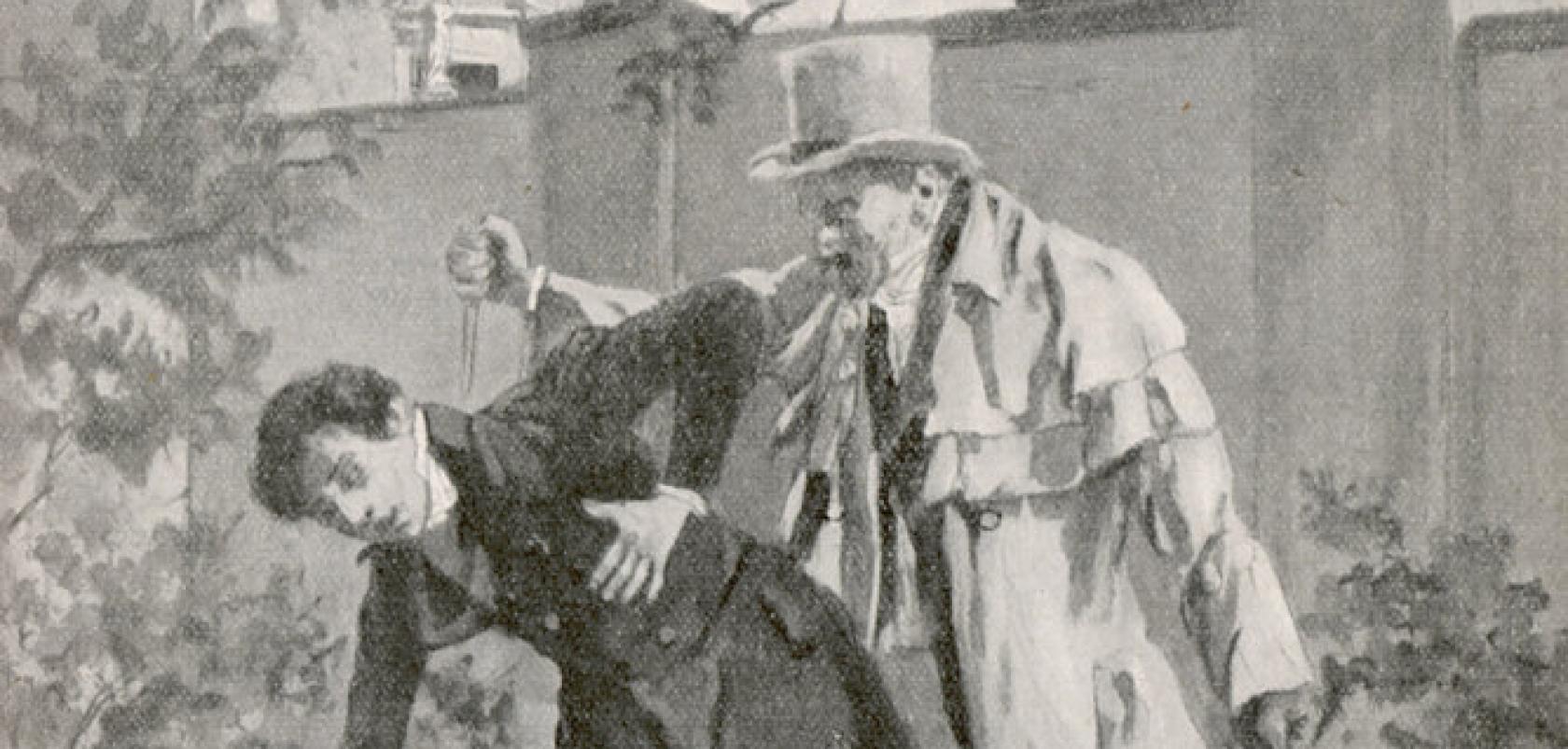
After that he seemed to disappear again, until eventually he turned up in California. In October of 1904, the San Francisco Call reported that Mulhatton sat in a jail cell in that city awaiting trial for stealing someone’s coat. In recent years, since his bout of insanity—which he attributed to being kicked in the head by a horse rather than to any alcoholic degeneracy—he had drifted westward, following circuses and relying on the charity of the Salvation Army. He presented himself as a phrenologist, one who can tell the content of a person’s character and even predict his or her behavior by feeling the lumps of the person’s head. Mulhatton appears to have been engaged in some similar bamboozling at the tavern where he was arrested, as he was said to have taken off his own coat to hold forth about a “mystic chart” and then put someone else’s coat on, which garment contained a bank roll in its pocket. Mulhatton is described as being wholly ignorant of the fact he committed a crime, but then he seems not to have been as sharp as he used to be, his wits likely dulled by whiskey as instead of the fast-talking genius he had become an incoherent mess. And no longer cutting the attractive figure he had previously been known for, he had gained weight and grown a red, bulbous nose. Such was his marked descent that the Call article went so far as to illustrate his decline with a drawing depicting his former self next to the sad, filthy version of himself that sat in the San Francisco jail. 

Illustration of Mulhatton both after his downfall and in his prime, from the San Francisco Call

Illustration of Mulhatton both after his downfall and in his prime, from the San Francisco Call

This story went far and wide, and later that month, an expanded version of it in the Chicago Tribune included further statements from the interview with Mulhatton in which he admitted that whiskey was the culprit responsible for his downfall. Therefore, it seems not only the loss of his job as a hardware drummer and his apparent financial straits could be blamed on his slowly worsening alcoholism, but also his erratic behavior and apparent bouts of insanity, a fact that had been suspected ever since his asylum commitment. And apparently he hadn’t even liked the stuff at first, but felt he had been forced to imbibe whiskey because he was so well known and so well liked that he was expected to liven up every party. In a sense, then, it was his stories that were his ruin, for it was his entertaining yarns that thrust him into fame and high society, where the life of the party never finds the bottom of his glass.

After his arrest in San Francisco, he disappeared again, and again there were rumors that he had died, which were again debunked in 1908 when he showed back up in Arizona, claiming to have discovered a copper mine. Then in 1913, another report of his death emerged. While out about his mining operations, he reportedly attempted to cross the Gila River, which was swollen at the time, and lost his footing, whereupon he was swept away. Several witnesses claimed to have seen the drowning, recovered his body and buried him, but the world and all posterity learned of it through, of course, a newspaper report, so it may be understandable if some believe this to be one final hoax that Mulhatton may have played on the public before fading into obscurity. And the fact that our knowledge of the past relies in large part on such publications so frequently misled and riddled with hoaxes causes one to begin to doubt much of received history. When parts of what we know about the past may actually be nothing more than concoctions penned by a hoaxer, then certainly we suffer from historical blindness.

* A variation in the spelling of his name as Mulhattan is common, but I have chosen to spell it as Mulhatton because that is how his name appears in the majority of the contemporary newspaper sources I found. 

Blind Spot: Tutelary Spirits

In our previous installment, we explored the weird and convoluted legend of the White Lady, a ghost that appears as a warning or fell omen that a prince of the Hohenzollern dynasty will soon perish. In researching this pale harbinger, I came to understand how tied up it was in ancient mythology as well as more recent history, and indeed, this phantom of Germany was not alone the sole example of its kind. It appears that the idea of a guardian spirit that is tied to an individual or a family can be found in the ancient traditions of Greeks, Romans and Celts. These entities were called daemons in Ancient Greece, and it was argued that they were part and parcel with human existence, tied in some mysterious way with our bodies or our souls. Socrates spoke of this daemon as though it were some divine force guiding his actions, but since then, many thinkers have suggested that he actually referred to something more rational and down to earth. Hegel believed that Socrates referred to his will, and Jung believed that what Socrates mistook for a spiritual guide was actually the unconscious. But these are modern rationalizations, and one can find notions of a guardian spirit, a phantom presence that protects and warns, throughout history, from the Roman Genius, which was a guardian spirit or family spirit, to the spirit guides of Native Americans. It is this tradition of actual spectral entities, many of which are described as bound not only to an individual but to a certain family, that the White Lady of the Hohenzollerns seems to fit into. They are often said to appear before some calamity or tragedy, as a silent forewarning, and there seem to be many of them in Germany and beyond. These guardians have another name; they are called tutelary spirits.

The Hohenzollern harbinger appears to be only one among a great many White Ladies in popular lore everywhere. In the United Kingdom alone, many come to mind. The White Ladies of the castle of Skipsea in Yorkshire, of Samlesbury hall in Lancashire, of Blenkinsopp castle in Northumberland, of Bolling Hall near Bradford, and those of Woodhouselee and Avenel all have their legends, in which women of various stations in life suffered various abuses and lunacies and perished by neglect or violence. The difference, however, is that these don’t appear to be tutelary spirits, their appearances not necessarily presumed to foreshadow anything in particular. In Ireland, however, there is legend of an undoubtedly tutelary spirit called a “White Lady of Sorrow” who is known to warn certain families of an imminent death among their ranks. This, of course, is the legend of the Banshee. It is supposed that a Banshee might be the spirit of any person who had in life encountered the family and loved them or had good reason to harbor animosity toward them. Thus the Banshee, who portends a family member’s impending death with its song, may sing a comforting air or shriek with hellish glee at its enemies’ forthcoming suffering.

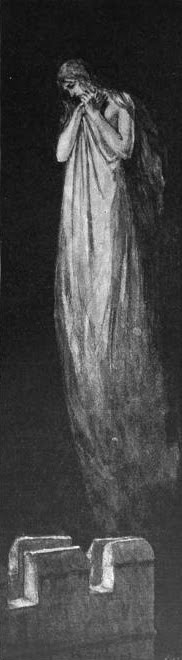
A friendly banshee depicted floating above ramparts.

A friendly banshee depicted floating above ramparts.

Nor is the Banshee the only singer among tutelary spirits. Scottish lore suggests that the chiefs of ancient houses had their own guardian spirits, Bodachs, who warned of a coming death, and one, the Bodach-an-Dun, or ghost of the hill, protector of the Shaw clan, is said to have sung in lamentation when the family lost its ancestral land

Sometimes these tutelary spirits, while still women like the Hohenzollern harbinger and the Banshee, differ noticeably in appearance, or more specifically in the color of their garments. Back in Germany, we find a legend out of Darmstadt of a Red Lady who appeared shortly before the unhappy death of Princess Alice, daughter of Queen Victoria. And in Bavaria, another is connected with the House of Wittelsbach, a family that has been haunted not only by spirits but by the specter of madness as well, with more than 20 members having gone insane within a hundred years. The spirit that haunts the Wittelsbachs in their ancestral castles at Fürstenried and Nymphenburg is also an ethereal woman, but rather than appearing as a young and fetching woman in white, she appears as an aging and haggard woman in a long black robe, with hair as white as a sheet. This Black Lady appeared prior to the death of King Maximilian II in 1864. According to the story, Maximilian’s wife, Marie of Prussia, beheld this fearful apparition standing behind her husband’s chair and looking at her with sorrow in her eyes before vanishing. Greatly frightened, she told the king what she had seen, and Maximilian, aware of the legend of the Black Lady, demanded of his guards what woman clothed in black they had allowed to enter the room, but of course his guards claimed not to have admitted anyone. Three days later, the king died suddenly, supposedly of a catastrophic attack of gastritis.

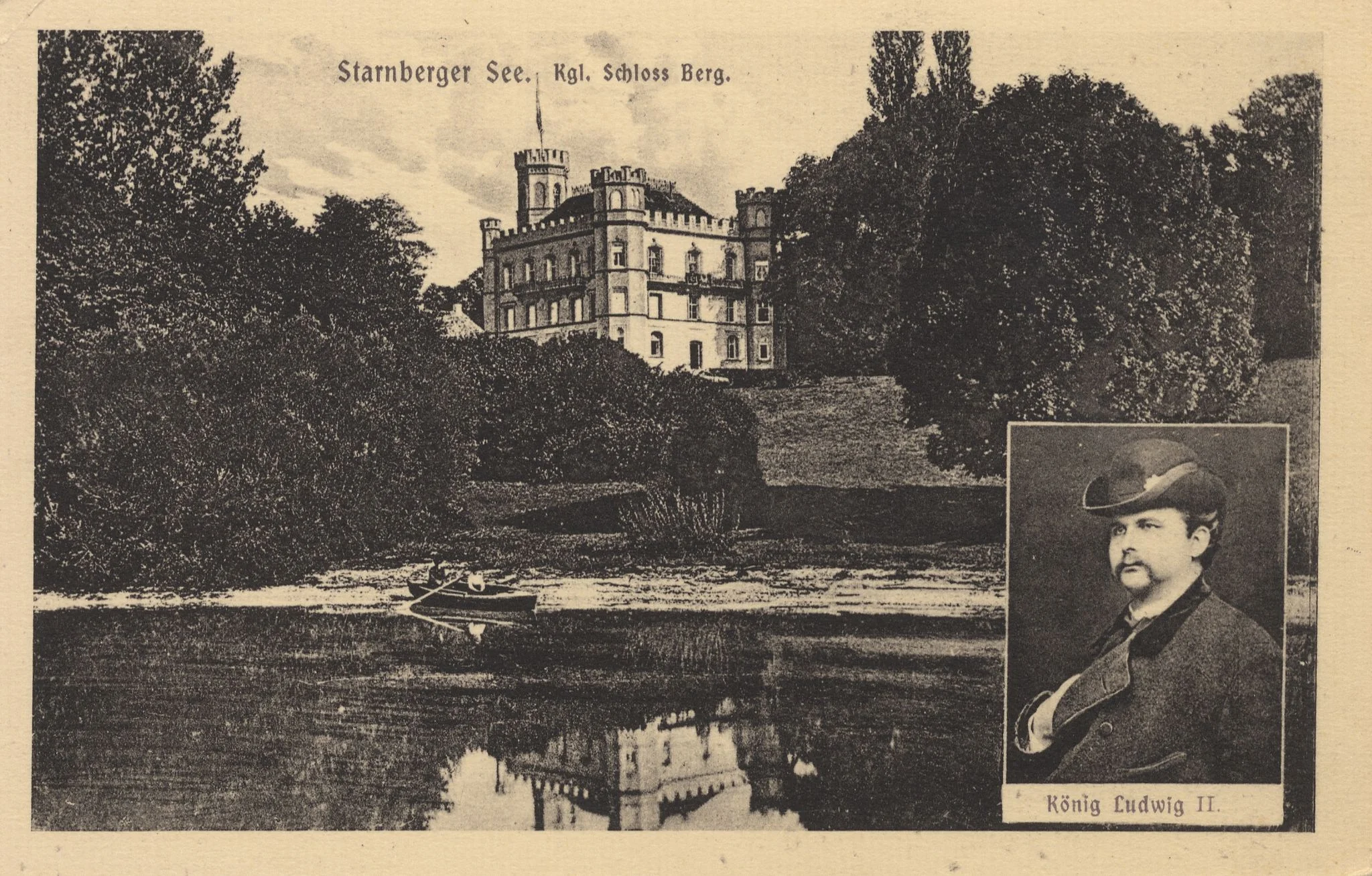
Maximilian’s son, then, is also said to have had his demise foretold by an appearance of this Black Lady. Ludwig is sometimes called the “Mad King,” because he was deposed when a psychiatrist declared him mad and therefore unfit to rule. In recent years, this evaluation has been brought into question, with some suggesting that Ludwig’s deposing had more to do with his debts and rumors of his homosexuality rather than any genuine insanity. Regardless, one night, a guard claimed to have seen the Black Lady floating at the opposite end of the King’s corridor. Chasing the spirit down to the courtyard, the guard demanded that she identify herself, but the figure made no reply, moving on through the moonlight. Nearing the chapel, the spirit turned to regard him. The guard then produced a firearm and discharged it, but it backfired, injuring him mortally. He had only time enough to tell the tale of his encounter to another alarmed sentry before dying. And true to the legend of the Black Lady’s appearance, the very next day, a great tragedy befell “Mad” King Ludwig while out walking the shore of Lake Starnberg. He had insisted on walking alone with the physician who had declared him unfit to rule. When they didn’t return, a search ensued, and they were both found dead in the lake, with the physician showing signs of having suffered some violence. It was thought that the Mad King had killed the doctor who’d betrayed him and then drowned himself, but no water was found in the King’s lungs, leaving the nature of Ludwig II’s death a mystery. But that tale may be better served if we save it for the topic of another episode…

Lake Starnberg, with portrait of "Mad" King Ludwig inset, via Zeno.org

Lake Starnberg, with portrait of "Mad" King Ludwig inset, via Zeno.org

As for these legends of tutelary spirits, it seems they do not always appear as spectral women. In France there persisted a tradition of a Little Red Man who showed himself at the Tuileries Palace just prior to some great calamity that would affect the ruling family of the land. At his first appearance, Marie Antoinette herself saw him in early August 1793; she and her attendants were lounging when they noticed him, a tiny man, clad in scarlet, with such an inhuman gaze that he seemed a goblin. Horrified, she and the others fled from the imp and told her mother what they’d seen. Within a few days, the bloody French Revolution had begun. This Little Red Man appeared again in 1814 to Napoleon’s son before Napoleon’s abdication and exile, but thereafter, many thought him a hoax because of one debunked sighting in 1815.  The Little Red Man appeared to some ladies and a chevalier while they sat dining. Coming out of the fireplace, he took a leg of mutton from the table and disappeared back up the chimney. This report certainly upset the royal family, who feared it portended some tragedy, and the King sent two chimney sweeps up the chimney to search out the scarlet imp, but neither of them returned! Only when he sent professional firefighter up the chimney was it discovered that some youths on another floor had cut a hole into the chimney in order to play the prank and had let the two chimney sweeps in on the joke. However, the legend of the Little Red Man did not die, for the creature was seen again in 1824 before Louis XVIII’s passing and again in 1871 before the fires of the Paris Commune

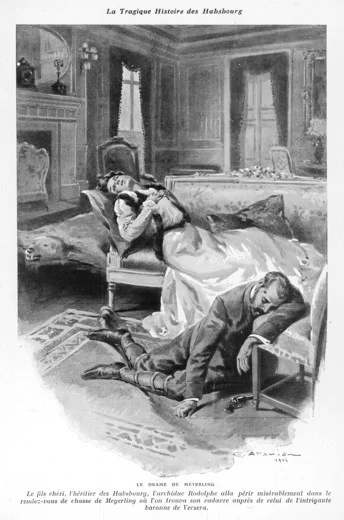
Indeed, it appears that legends of tutelary spirits associated with royal families do not always even take the form of a person. Legend has it that, before the transpiring of terrible events that touched the lives of those in the Habsburg dynasty of Austria, preternaturally large white birds were seen flying in the daylight. These unearthly creatures, called the Turnfalken, were said to fly by night, hidden in darkness, and only made daytime flights to forebode some ill omen for the Habsburgs with their strange and shrill cries. As with others of these tutelary spirits, the Turnfalken were seen in flight before numerous Habsburg deaths, some of them quite unexpected, such as that of Duchess Sophie Charlotte, who died in a fire at a Paris bazaar. One of the most notable Habsburg deaths presaged by the flight of the Turnfalken was the mysterious death of crown prince Rudolph in what is known as the Mayerling Tragedy. This incident, in which the crown prince and his mistress were found dead in the imperial hunting lodge, has remained a mystery, as none can be certain whether their deaths resulted from murder, suicide, or some combination thereof. But that, again, may be a story to explore in a future episode, so let us not dwell long on it, for the Turnfalken flew on through the years. Before the assassination of Archduke Franz Ferdinand, for example, there are reports that a flock of Turnfalken were seen wheeling around the skies above Vienna, shrieking. And before the death of Emperor Franz Joseph I two years later, it is said the Turnfalken circled the city in such great numbers that they sparked a general panic among the populace.

A depiction of the scene at the Mayerling Tragedy

A depiction of the scene at the Mayerling Tragedy

To the enlightened modern mind, these legends of tutelary spirits not only smack of superstition but also may seem backward in their outmoded notions of the superiority of nobility and royalty, that for some reason families of a certain breeding were special and warranted the protection of spiritual guardians. All too often, though, we look at the past through the lens of the present, judging our forebears according to our own worldview instead of meeting them on their own terms. If we fail to understand that the people of the past lived in a world of spirits and magic, then we are blinded to the true nature of their existence and perhaps to an entire facet of the human experience. Consider the words of Sir Walter Scott: “Unaided by revelation, it cannot be hoped that mere earthly reason should be able to form any rational or precise conjecture concerning the destination of the soul when parted from the body; but the conviction that such an indestructible essence exists…must infer the existence of many millions of spirits who have not been annihilated, though they have become invisible to mortals who still see, hear, and perceive, only by means of the imperfect organs of humanity.” 


The White Ladies of German Lore

In this installment, we’ll take a look at a story that, while certainly mysterious and certainly historical, leans somewhat more toward legend and the supernatural. As such, the sources I’ve had to rely upon have been spare and rather less credible than I would like, but such is the nature of stories like these, and indeed, like the old classic show Unsolved Mysteries and like much of the more popular programming on the History Channel, I may occasionally dip my toes into the murky waters of the paranormal, just as I may sometimes enter the realm of true crime and politics. Be assured, however, that my central theme of scrutinizing the blind spots in our past shall remain intact.

The subject of this episode actually came up in my series on Kaspar Hauser, Foundling of Nuremberg, Wild Boy of Bavaria, and Child of Europe. In the second part of that series, I explored the theory that Hauser had been a crown prince of the Grand Duchy of Baden, stolen from his nursery and swapped out with a sickly babe by an evil second wife of his great grandfather. This woman, Countess Hochberg, according to the legend as told in multiple sources, dressed in white in order to impersonate a famous ghost whose appearance was known for presaging the death of princes. Thus she is said to have frightened away any who might have questioned her presence in the nursery and witnessed Hauser’s abduction and replacement with a changeling. I reported, based on the sources associated with Hauser’s story in which I had found the detail, that this spirit was called the White Lady of Baden, and to be certain, I was intrigued by this story. However, as I looked further into the story and began to entertain the idea of focusing an entire installment of Historical Blindness on this legend and its origins, I realized that my sources were in error, at least in a way. For every source I have been able to find on the White Lady records her appearances in the Old Schloss, the city palace in Berlin, which is indeed far from Baden. However, as I investigated the tales behind the story of the Weisse Frau, the White Lady of the Old Schloss, I found that this apparition was identified not only with the Berlin Palace but also, through her supposed origins, with other White Lady legends, apparitions that were supposed to have resided in various other locations throughout Germany. Therefore, as a retraction and mea culpa of sorts, I am happy to present The White Ladies of German Lore.

*

The Berlin Stadtschloss, or City Palace, began as a fortification on the Spree River built by Frederich II, Hohenzollern Elector of Brandenburg, in the mid-fifteenth century, with part of a city wall integrated on its eastern side. The palace served as the winter home of the Hohenzollern family for three centuries thereafter, and became the hub of government and society. Successive monarchs renovated and expanded the palace, adding new wings until it became something of a hodge-podge old pile, but nevertheless, it remained a symbol of government and power well into the 20th century. Listeners may recall that the Old Palace was one of the landmarks that Marinus van der Lubbe had tried to set on fire before succeeding in burning the Reichstag. It was something of a hulking and rambling monstrosity, especially in its heyday, with 600 lushly furnished rooms, grand gala suites and banquet chambers, all connected by great pillared halls lined with frescoes and sculptures—to say nothing of the sumptuous royal apartments and throne room! And then there is the dark tower, with its onion cupola plated in copper that after tarnishing earned it the name “The Green Hat,” where Frederich II, nicknamed the “Irontooth,” is said to have gravely conducted traitors to the Iron Maiden, silencing their screams when he shut them up inside. 

The Berlin Schloss with Green Hat visible, via antique-prints.de

The Berlin Schloss with Green Hat visible, via antique-prints.de

Such a palace, as it slipped slowly into disuse and decrepitude, can be imagined as the very model of a haunted castle, and indeed, a specter was seen there quite frequently. One of the earliest records of people claiming to have seen the spirit comes from just before the turn of the 17th century, in 1598, when another Hohenzollern Elector of Brandenburg, Johann Georg, lay dying, and thus the legend that this apparition foretold the imminent doom of Hohenzollern princes was established. Such was the pervasion of this legend that before Elector Johann Sigismund’s death some 20 years later, he asked the chaplain of his court more than once if the spirit had been seen. We know from the chaplain’s own writings that the existence of the spirit was not a matter of debate, as it had been seen so many times “by individuals of all ages and conditions.” Rather, the real questions were of the disposition and intentions of the spirit. The chaplain believed the apparition, which appeared as an ethereal woman in a white dress, to be benevolent, as its presence provided a warning to princes of their looming demise.

And indeed, the White Lady had been spotted by a page in the days before Johann Sigismund’s death, in a corridor near the tower of the Green Hat, where it is traditionally held that the spirit resides in some hidden room. This page, it is said, upon catching sight of the spectral woman, tried to make a pass at her, attempting to snake an arm around her waist while saying, “Lovely mask, where goest?” His arm passed through her as through a fog, and the spirit, raised one of the keys she was said to carry, which keys some suggested she used to enter any room in the palace, and tapped him on the forehead with it. The page shared his story with whoever would listen, and as the legend goes, he grew pale and slender and more feminine with age, he who had once been a masculine and ruddy sort of fellow. It was reported that, as this went on, his steps began to make less and less noise, until the transformation seemed complete and he flowed about like a very ghost, frightening women who mistook him for the White Lady. Upon his death, the legend says that only a sack of bleached bones were found in his bed.

Thereafter, the ghost was seen by another man of the cloth in 1628, when she is reported to have uttered a statement in Latin: “Veni, Judica vivos et mortuos!” which translates to “I have come to judge the living and the dead.” Thereafter, she appeared in the mid- to late-1600s prior to the death of Anna Sophia, Duchess of Brunswick, and before the death of Elisabeth Charlotte of the Palatinate, mother of reigning Elector of Brandenburg Friedrich Wilhelm. During the latter of these appearances, it is recorded that she was witnessed by a courtier named Kurt von Burgsdorf who had earlier expressed a general disbelief in the spirit’s existence, suggesting that he would have to lay his own eyes on her to give credence to such tales. One night, after the Elector had retired to bed, Burgsdorf saw the spirit upon the back stairs leading to the garden, and he cursed her, asking if her thirst for the princely blood of Prussia had not already been slaked. In reply, the White Lady is said to have thrown him down the stairs, making such a noise as to wake the Elector from his slumber.

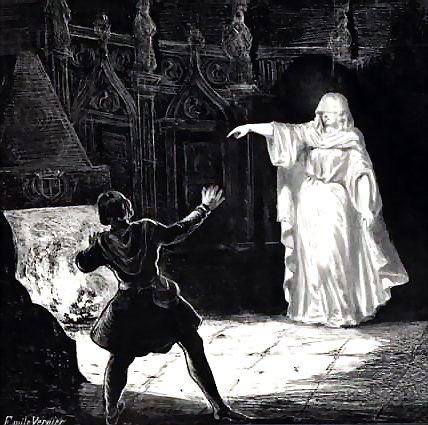
Some years after that, in 1667, another report of the White Lady being seen in the very bedchamber of Electress Louise Henrietta. In this instance, the electress herself saw the apparition sitting in a chair and writing, whereupon the White Lady rose, bowed and disappeared. Then, sure as night follows day, not long after this encounter, Electress Louise Henrietta of Nassau passed away.  And so it went throughout the years. In 1678, Erdmann Philip, Margrave of Brandenburg, found the White Lady sitting in an armchair in his bedchamber, and thereafter he died of injuries sustained on the race course when his horse fell. Then she was seen several times in 1688, the year in which the Great Elector, Friedrich Wilhelm, died, and was in fact seen the very day of his death by the court chaplain at the exact time of the elector’s passing. And then on to Friedrich Wilhelm’s son, Friedrich I, King in Prussia, who was supposedly woken in the night by the White Lady who parted the hanging fabric over his bed to give him a good look at her and then drifted into the adjoining room to make a great clamor of crashing dishes, like a very poltergeist. Friedrich I is said to have ordered a coffin made the very next day and promptly died that evening. 

The White Lady appearing to Freidrich I, via Wikimedia Commons

The White Lady appearing to Freidrich I, via Wikimedia Commons

However, another version of this story suggests he did not see the White Lady at all. Rather, it is said that his jealous wife, Sophia Louisa of Mecklenburg, believed the king had a beautiful young countess in his bedchamber, and in the middle of having her hair powdered, she flew into a rage and ran down a corridor with a sheet around her, leaping through a glass door to enter the king’s chamber. Upon waking to see this bloody, powdered figure in a bedsheet, he fell in a fit, crying that he had seen the White Lady and was surely lost. Despite being told the truth, he came down with a fever and perished. Therefore, even if this were not a genuine apparition, still a White Lady appeared to him, portending his demise, just as would be the case with this son, Friedrich Wilhelm I, known as the Soldier King, who legend says saw the spirit while drinking a bowl of beer and, coughing, set down the bowl, said merely, “Well, we must be going,” and died of what has been termed “alcoholic degeneracy” that very night. Whether a true ghost or some other figure wearing the guise of the shade as the Countess of Hochberg is supposed to have done when kidnapping Kaspar Hauser, it seems that even just the belief that one had seen the White Lady was enough to send a healthy prince into the grave.

The Soldier King’s son, Frederick the Great, however, was not a believer. Out of bravado or overcompensation, he openly scoffed at the notion that the White Lady was real, even though popular wisdom told him that his forefathers had all seen her. But he may have been far more obsessed with the tale than he let on. Apparently he took the time to paint a picture of the White Lady, which he gave to his sister. And once, with the writer and philosopher Voltaire, with whom the king had formed an affectionate and mutually flattering though short-lived friendship, he went on a midnight hunt for the ghost, holding candles aloft as they traipsed through the Old Schloss’s many darkened rooms. At one point, when Frederick took a corner and lost Voltaire, it’s said that the atheist intellectual and dandy, perhaps jumpy from his legendary overconsumption of coffee, went quite mad with fear, dashing across rooms and upsetting furniture and other things in his terror. Some sources say that Frederick the Great himself never saw the White Lady, despite his preoccupation with her. However, shortly before his death, his Queen and her entire household claimed to have seen the apparition looking out from a turret of the Old Schloss. And other sources contend that, eventually, Frederick the Great saw her after all, though not in Berlin. Rather, he saw her at his summer palace in Potsdam, striding through his library without sparing him a glance. It cannot be said that he feared her, or at least that he couldn’t overcome his fear of her, for he bravely followed her, finding her always across the room and entering the next, far from his reach, although she turned and beckoned to him. He died soon afterward in the same library in which he had seen her, and it is reported that he passed while looking intently at something—or someone—in the corner invisible to all save him.

A depiction of a White Lady apparition, via Wikimedia Commons

A depiction of a White Lady apparition, via Wikimedia Commons

It may seem strange that the spirit would appear beyond the walls of the Schloss, but actually sightings of the phantom appear not to have been bound to the Berlin city palace. She is supposed to have appeared to a Hohenzollern count at Hohenzollern Castle in the Swabian Alps during its siege by the Free Cities of Württemberg, pacing the ramparts, wringing her hands and sobbing, heralding the impending loss of the beleaguered stronghold. Here again, a story has the Hohenzollern count’s wife disguising herself as the White Lady in order to leave the castle unmolested during its siege and thereby resupply their stores of ammunition, so perhaps some sightings of the White Lady beyond Berlin were actually of impostors in costume. The tales of the White Lady showing herself beyond Berlin are numerous, however, including appearances in Schalksberg,  Plassenberg and Ansbach, and when we consider the origins of the legend and try to pin down who the White Lady may have been in life, who her “original” was, so to speak, we begin to see that the spirit was rather well-travelled . . . or that in fact there may have been more than one White Lady in Germany.

The most common account holds that the White Lady is the ghost of one Agnes, Countess of Orlamünde, who bore Count Otto of Orlamünde two children before his death in the mid-14th century. Thereafter, Agnes is said to have fallen madly in love with a younger man, Albert “the Handsome” of the Hohenzollerns, Burgrave of Nürnberg. When she confessed her feelings, Albert supposedly told her that he would marry her, but for the fact that there were “four eyes” watching him, standing in the way. According to the story, Albert meant his parents, who disapproved of their marriage, but Agnes believed he meant her two children, and in order to remove this impediment, she murdered them both by driving a golden needle into their brains through their ears. Some versions of this story vary, asserting that her weapon was not a golden needle but rather a silver hairpin or a spinning needle, and some suggest that, after Albert discovered her horrific crime and rejected her, she went mad and killed herself while others follow her journey of redemption to Rome and thereafter to Himmelskron where she supposedly founded a convent and died there as its abbess.

While the story of Agnes of Orlamünde may provide a perfect backstory for the spirit, it is problematic, historically speaking, as it appears Otto of Orlamünde’s wife was named Beatrix, not Agnes. It may be that this figure has been confused with or is a corrupted version of one Kunigunde of the Landgraves of Leuchtenberg, who married a subsequent Otto of Orlamünde, and though she did not found it, she certainly contributed to the convent at Himmelskron in the form of an endowment. History may not have recorded the murder of Kunigunde’s children, but popular legend says she likewise killed her son and daughter with a silver hairpin.

Tombstone of Kunigunde von Orlamünde at Himmelskron, via Wikimedia Commons

Tombstone of Kunigunde von Orlamünde at Himmelskron, via Wikimedia Commons

In the mid-15th century we find another likely suspect in the form of Perchta (or often, alternately, Bertha) von Rosenberg who was cruelly mistreated by her husband, John von Lichtenstein of Steyermark. After his death, she moved to Neuhaus in Westphalia where she had a castle built for herself. For the rest of her life, she was known to wear only white out of mourning, such that even in her portraits she appears remarkably similar to the White Lady, in a white gown and white veil, carrying roses and a ring of keys, both of which are known to be items the White Lady has been seen to carry. The spirit of Bertha von Rosenberg was first known to haunt her castle at Neuhaus, but she is said to haunt other locales as well, wherever her family had settled or expanded. As the Rosenbergs had married into the Hohenzollerns as well as the royal families of Hesse and Baden, this means she has been seen across many German regions and principalities, from Berlin to Bavaria and elsewhere, which appears to explain the misnomer of the “White Lady of Baden” used by some authors when discussing the story’s intersection with that of Kaspar Hauser. And indeed, it seems some surviving accounts confuse Bertha von Rosenberg with Agnes or Kunigunde of Orlamünde, suggesting that after she was widowed, it was she who killed her children to win the love of Albert the Handsome, and that she afterward threw herself from a window of her castle at Neuhaus.

Further confusing the origins of the White Lady legend and particularly its association with Bertha von Rosenberg is the historical presence of another Bertha, a Hohenzollern who married Rudolph II of Burgundy and was depicted on the throne with a spindle rather than a scepter, and another Bertha commonly called the Goosefoot Queen, who reigned as Queen of the Franks with her husband, Pepin the Short, and who was said to have had a broad and flat foot as a result of her constant pedaling of a spinning wheel. These real Berthas appear to have been identified with a figure from Swabian folklore, Bertha the Spinner, who is said to carry a spindle and stomp her flat foot in anger when displeased. Indeed, the legend of Bertha the Spinner itself may have been the inspiration of the White Lady, as she is said to wear white robes. Moreover, she comes forth at Christmas time to reward or punish children according to their behavior, like Santa Clause, but considering the fact that she wields a spindle when she comes for the children, it is not hard to discern some intersection here with the legends about Agnes or Kunigunde of Orlamünde, for it must be remembered that in some versions of their tale, she killed her children with a spindle. And just to give some idea of how these legends continue to spider-web in every direction, these historical Berthas and this legendary goose-footed spinner, in addition to being comparable to the figure of jolly St. Nickolas, also may have been the origin of Mother Goose.

Bertha von Rosenberg, via Wikimedia Commons

Bertha von Rosenberg, via Wikimedia Commons

A century later, in the mid-1500s, we find another couple of figures commonly identified with the White Lady, both being women who were ill-used by Joachim II, Elector of Brandenburg. Joachim II is known to have greatly expanded the Old Schloss of Berlin during his time, which necessitated that he purchase some of the buildings around it, and one story suggests that he turned a certain old woman out into the street when she refused to sell him her house. This version suggests it is this old woman who has haunted his descendants ever since. The other version of the story suggests that the White Lady is actually one Anna Sydow, the widow of a gun maker who was beautiful enough to draw the Elector’s attentions. According to one source, whether by expanding the palace or by showering his mistress with extravagances, Joachim II went broke and ended up seeking the help of an alchemist called Philoponus Philaretus, who promised to make the Elector 300 million gold coins using only one small grain of thePhilosopher’s Stone. Like many of the sources I’ve been able to find for this episode, most of which vary in their details or contradict one another (and which I have tried dutifully to document in the blog entry), this tale of a mysterious alchemist, which of course intrigued me, could not be substantiated at all. The name appears to correspond with pseudonymous characters Robert Boyle later used in his writings, so it’s possible that they were common names in the lore of alchemy or even commonly used as aliases among confidence men posing as alchemists. The latter appears to agree most with the story, which says that Joachim II died suddenly without seeing the windfall promised to him by the alchemist, who promptly disappeared. Before the Elector died, he made his son promise to take care of his mistress, Anna Sydow, but his son either broke his promise or interpreted his obligation oddly, for he immediately locked her up in a tower at Spandau, where she languished until her death. Thus it is said that Anna Sydow haunts not only Spandau but also every residence of the family of her beloved. The Elector’s son, it should be noted, was none other than Johann Georg, mentioned earlier as one of the first Hohenzollerns to have his death foretold by the White Lady’s appearance. However, some have suggested that Anna Sydow could not have been the White Lady, as she is said to have seen the specter herself, as had her beloved Joachim II, indicating that the spirit existed long before her imprisonment and death.

And indeed the stories of the White Lady may derive from legends and folklore with an even longer history than any I have so far mentioned, stretching back all the way to Norse mythology and the Nibelungen Lay, a pre-Christian epic poem featuring dragons and a mystical treasure, for a very similar apparition robed in white is said to haunt the rocky Swabian hills, carrying roses and tapping her magical keys against rock faces to open hidden doors and give glimpses of the long vanished Nibelungen treasure. And tracing even farther back into the pre-Christian Norse mythology from which the Nibelungen Lay was derived, we find a goddess named variously Freya or Frigga, and significantly enough, in ancient Germanic tradition, called Bertha. The bride of Odin, Bertha is described as white-robed, a bringer of life and death, and called by some the Ancestress, as she is thought to be the forerunner of all Germanic nobility and royalty. To further tie her back to the White Lady legend, this Freya/Bertha goddess was conflated or syncretistically combined with Bertha the Goosefoot and Spinner, in that some parts of Germany celebrate Berchtentag, or Bertha’s Day, by eating the foods considered sacred to the goddess Freya and praising geese and all other white things as sacred.   And there may also be some confusion or conflation of the many Berthas already mentioned with the Teutonic goddess Perchta, goddess of the moon and bringer of winter, who is depicted as a widow bemoaning the loss of her late husband, the Sun. Her children are the flowers in the field and the foliage in the tress, which she slays with another kind of silver needle: an icicle.

Frigga depicted with needle in hand and two infants beside her, via Wikimedia Commons

Frigga depicted with needle in hand and two infants beside her, via Wikimedia Commons

Whether the White Lady of the Old Schloss of Berlin is in fact a goddess, or whether she is the spirit of a once-living woman—or as has been suggested before, an entire line of women who have been doomed to haunt the Hohenzollerns, or whether she is a simple myth perpetuated by the mistaken, the playful and the dishonest, it is certain that sightings of her continued well into the late modern period, haunting every royal German family throughout every region of Germany. In the late 18th century, she seems to have moved out of her comfort zone, haunting others besides the great families of Germany, as France’s King Louis XVI, while being held for trial during the revolution that overthrew his rule, apparently asked those around him if they had seen the White Lady, explaining that she appeared when princes of his house were about to die. And in 1812, during the French occupation of the palace at Beyreuth, she is said to have thrown over the bed of Napoleon Bonaparte and tried to strangle him. Perhaps the most recent report of the White Lady has her appearing to foretell the death of an Austro-Hungarian of the Habsburg-Lorraines, and in the process ushering in the doom of a generation, as she is rumored to have appeared in 1914 before the assassination of Archduke Francis Ferdinand and the commencement of the Great War, a conflict that would result in the abdication of the last Hohenzollern emperor, Wilhelm II.

Granted, ghost stories are not history, but they often have a historical inspiration. When wading through such muddied historical context as this, with persons who may not have existed, and figures who have been confused and combined in memory, who have been mixed up and mythologized, we again see the weakness in our records of history, the blind spots in our recollection of the past. One might even imagine that “The White Lady” of Ferdinand Freiligrath’s poem, she who “attired in white, appears / with mourning and with wailing, with tremors and with tears,” is speaking of our historical blindness when she chastises us, saying, “’You note them not; you blindly face the hosts of Hate and Fate! / Alas! Your eyes will open soon—too soon, yet all too late!’” 

Blind Spot: The Lady of the Haystack

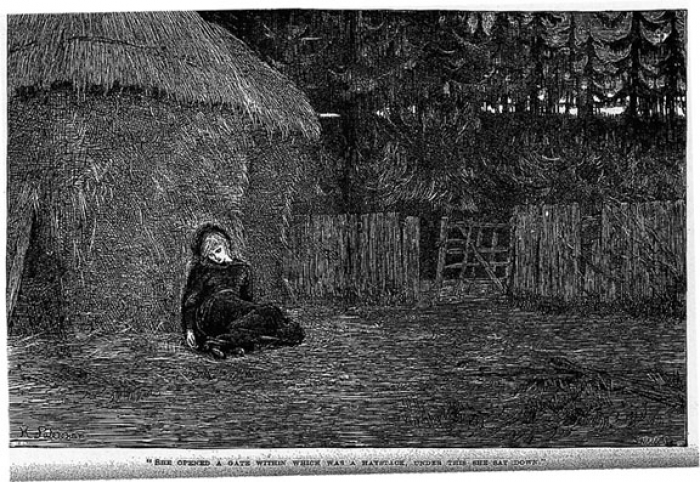
In a little village called Bourton outside Bristol, a beautiful but troubled woman appeared in 1776. By all accounts young, elegant, shapely and graceful, she enchanted those whom she encountered, who worried for her on account of the destitute condition she appeared to be in. Nevertheless, she never complained about her situation or begged for any charity beyond a drink of milk. Indeed, although everyone she encountered entreated her to come indoors and accept shelter in their homes, and especially the village women who warned her how unsafe it was for a woman alone to sleep out of doors, this unusual creature refused all their offers, choosing instead to slumber beneath the makeshift shelter of haystacks in the fields of Bourton, for as she said, “trouble and misery dwelt in houses, and that there was no happiness but in liberty and fresh air.”

Never did she share her true name with the townsfolk, who assumed from her bearing and mien that she was of high birth. In the absence of a name, he was given one: Louisa. Throughout her time in Bourton, many attempts were made to ascertain who Louisa was and whence she came. She spoke English, but with some peculiarities in pronunciation and sentence structure, such that most believed she was foreign born. One gentleman spoke to her in a variety of European tongues, most of which appeared to make her uncomfortable, and when he spoke German, she turned away, overcome with emotion and sobbing.

Walking to and fro, she showed kindness to children and accepted gifts of milk and tea and simple foods but refused the extravagances of fine clothing and jewelry, which she discarded atop bushes as though they were things of little interest or beneath her. Thus she abided in Bourton for four years, making her home among the haystacks the entire time, except for a short stay in St. Peter’s hospital in Bristol, where she was treated for insanity and promptly released. Age, illness and exposure to the elements took a toll on her beauty, but nevertheless she remained an enchanting woman. Fond of her and concerned for her well-being, the people of Bourton placed her under one Mr. Henderson’s care, in his private insane asylum in Gloucestershire. Although she had not wished to go, her health did appear to improve there. Her lucidity, however, appeared to wane, and she descended into some form of cognitive impairment, called in that era not derangement or dementia but rather “idiotism.”

Depiction of a similar scene, via The Natural Navigator

Depiction of a similar scene, via The Natural Navigator

While her wits deteriorated, those who cared for her refused to give up on finding where she had come from and perhaps reuniting her with family. Based on her reaction to spoken German, they believed her to be of German origin. Therefore, as she languished in Henderson’s Gloucesterhire madhouse, her friends composed a narrative relating all they knew about her appearance in England and her behavior there, and this they published in the newspapers of a variety of major German and French cities. To their disappointment, nothing came of the narrative’s publication, at least not at first. Some years later though, as Louisa, the Lady of the Hay-Stack, continued to deteriorate in her room at the madhouse, a fantastic pamphlet purporting to reveal the secret of her origins was published anonymously in France. This mysterious pamphlet was titled The Stranger, a true history, and it began with an introduction of sorts that gave the particulars of Louisa’s previously published narrative before tantalizingly suggesting that this poor Lady of the Hay-Stack might indeed be one and the same as the subject of the narrative it went on to share.

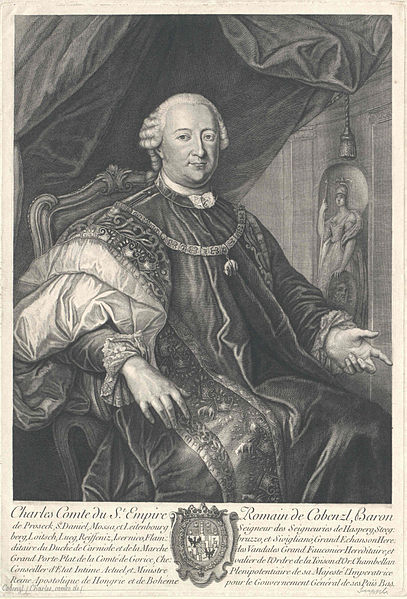
The pamphlet began its story in 1768, when one Count Cobenzl, minister plenipotentiary of the Austrian Netherlands under Holy Roman Empress Maria Theresa, received a cryptic letter from a woman at Bourdeaux calling herself Mademoiselle La Frülen. In this letter, she said that she had written to him because of how universally respected he was. She was soliciting some undefined aid from him, and she assured him that when he knew who she was, he would likely be glad to have helped her. Cobenzl then received another letter signed by a Count Weissendorf from Prague suggesting that Cobenzl do all he can to help this La Frülen woman, and to advance her money if she desired it, for again, “when you shall know, Sir, who this stranger is, you will be delighted to think you have served her, and grateful to those who have given you an opportunity of doing it.” And then another similar letter from one Count Dietrichstein of Vienna arrived, entreating Cobenzl again to help this stranger with a false name.

Cobenzl replied to La Frülen that he’d be happy to help her but must be told her real name. Their correspondence continued, and as she prevaricated, Cobenzl was visited by a woman from Bourdeaux who knew the mysterious letter writer, speaking very highly of her and sharing with Cobenzl that, due to her mysterious origins and the fact of her remarkable resemblance to the late Holy Roman Emperor Francis I, founder of the Habsburg –Lorraine dynasty, many rumors had arisen about her extraction. Meanwhile, La Frülen assured Cobenzl that she would tell him everything, but for the time being she sent him a portrait of herself, saying that it might give some hint as to what she would tell him. The subject of this portrait appeared to bear a remarkable resemblance to the late emperor, and this judgment was made by none other than the late emperor’s own brother, Prince Charles of Lorraine, whom Count Cobenzl had shown the painting.

Portrait of Count Cobenzl, via Wikimedia Commons

Portrait of Count Cobenzl, via Wikimedia Commons

As Cobenzl continued to exchange letters with this stranger, she sent him further portraits, this time of the empress and the late emperor, suggesting Cobenzl compare her portrait only to the latter. The implication was quite clear, and Cobenzl felt he had to tread rather carefully, yet he continued to receive letters from elsewhere commending him for helping this Mademoiselle La Frülen and beseeching him to keep her secret. After about half a year of this, though, in the early months of 1769, he received letters of a different sort. These communications from Vienna indicated that the authorities were in the process of arresting this La Frülen in Bourdeaux and shipping her to Brussels to be questioned by Count Cobenzl himself. For it appeared that the King of Spain had also received a letter about this woman in Bourdeaux, this missive purporting to be from Emperor Joseph II himself claiming the girl as his half-sister and the natural born daughter of the late Francis I, but when the King of Spain contacted His Imperial Majesty about this letter, the Emperor denied writing it, informed his mother, the Empress, that a forger and impostor in Bourdeaux was seeking to pass herself off as a Habsburg-Lorraine and forthwith dispatched legal authorities to apprehend her!

Upon arriving at Brussels and being conducted to Count Cobenzl, the mysterious Mademoiselle La Frülen charmed everyone with her beauty and bearing, and surprised some with her striking resemblance to the late emperor. She appeared to be under the impression that her arrest was due to debts she had incurred in Bourdeaux, which had been her reason for writing to Cobenzl for aid in the first place. The tale this woman shared with Cobenzl and her other interrogators was a sad one indeed. She had no notion of her birthplace, but believed she had been raised in Bohemia, where she remembered a remote country house and two kind women who nurtured her, and a man of the cloth who occasionally visited to say mass and catechize her. The women took it upon themselves to teach her to read and write, but this priest, upon discovering the fact, forbade it.

Thus she persisted, a chaste and pious youth sequestered from all society, until a man she did not know came to visit her wearing a hunting-suit, put her on his knee and remarked upon how grown she was. Lovingly, he encouraged her to behave well and obey her guardians, and he took his leave. He made a great impression on her, and when he returned more than a year later, dressed again as though out on a hunt, she committed his features to memory, such that she could and did describe him in detail to Count Cobenzl and her other interrogators. At the conclusion of the man’s second visit, she wept, and he appeared moved, promising to visit again soon. However, he did not return for two years, explaining then that he had intended to visit sooner but had taken ill. During this third encounter, the youthful Mademoiselle La Frülen expressed her familial love for the man, and he likewise expressed love for her, promising to see to all her needs and provide her an opulent life of wealth. He then gave her three portraits, one she recognized as being of himself, which he admitted, and one of a regal-looking woman. These, she claimed, were the portraits of the late Emperor Francis I and Empress Maria Theresa that she had sent to Count Cobenzl. The third portrait depicted a veiled woman, which the man claimed was her mother. Along with the portraits, he gave a gift of money and a promise to soon fulfill all her grandest wishes, but he also made her vow never to marry.

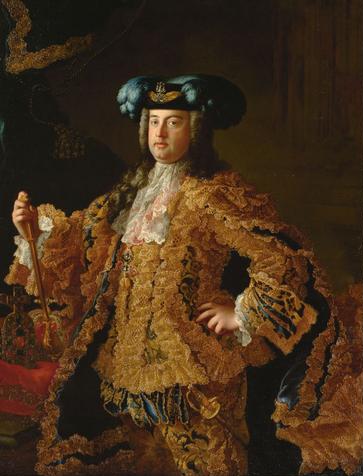
Portrait of Emperor Francis I, via Wikimedia Commons

Portrait of Emperor Francis I, via Wikimedia Commons

The implications of the tale were clear. If the man had been the same as the subject of the portrait given to Cobenzl, that made him Emperor Francis, and some other particulars of the tale indicated that she was supposed to have been his daughter. For example, in explaining to her some article of his clothing as an officer’s distinction and then endeavoring to explain what an officer was, he indicated that they were honorable and gallant men whom she should love, being herself the daughter of an officer. And later, when asking her whether she would like to meet the Empress, he said, “You would love her much if you knew her, but that for her peace of mind, you must never do,” implying some secret kept from the Empress. Thus the fact he always visited in hunting clothes, for what better excuse to make a visit to the countryside than a hunt. And La Frülen’s descriptions of his features, and in particular a distinguishing pale mark on one of his temples, seemed to fit the late Emperor Francis exactly. In fact, the detail that he had become ill during a specific period was corroborated by the late Emperor’s brother Charles, who recalled Francis becoming ill after returning from a hunting trip around that time.

Eventually, the priest who taught her catechism informed her that the kind visitor she so loved had passed away and had left instructions that she be taken to a convent. So terrified was she of life in a convent that she fled from her chaperones during the journey, ending up sleeping in a barn. Thereafter, relying on the charity of those she encountered, she was able to find passage to Sweden on a carriage but fell from the conveyance during the journey, suffering a grievous head wound and having to stay with a Dutch family at their inn until her recovery. Thereafter continuing to Stockholm, she encountered the first of a series of charitable noblemen who, on account of her resemblance to the late Emperor and based on cryptic recommendations to offer her aid, took her in, provided her with gifts and loans and generally saw to her every need and comfort. Everywhere she went in those years, from Stockholm to Hamburg to Bourdaeux, she fell in with an aristocratic element, who often received letters from afar entreating them to offer her succor and charity, hinting at the tantalizing secret of her lineage.

Such letters, of course, Count Cobenzl and his fellow interrogators were well familiar with, and they informed Mademoiselle La Frülen that she was not in custody because of the many debts she had accumulated in Bourdeaux but rather for the forging of letters and for fraudulently posing as the daughter of Emperor Francis. In great distress, she admitted to having forged the letter from Emperor Joseph II to the King of Spain as well as some other letters, but she justified this based on the threats she had received from creditors and refused to recant the story of her youth and its implications that she was a natural born daughter of the Emperor. As for many of the other letters, some of which Count Cobenzl himself had received recommending him to offer her aid, she claimed absolute ignorance of them, suggesting that her father must have instructed a great many people to see to her welfare, and that they continued to do so from afar.  Moreover, she indicated that she had no desire to continue seeking charity from others but that she had no choice because of the vow she had made never to marry. Several advantageous proposals had been made to her in Bourdeaux that would have seen her well taken care of, but she had refused them to keep her promise.

Portrait of Empress Maria Theresa, via Wikimedia Commons

Portrait of Empress Maria Theresa, via Wikimedia Commons

Having received the details of this interrogation, the Empress was disposed to treat the prisoner as severely as possible, but before any action was taken against her, Count Cobenzl became very fatally ill. While on his death bed, he received a mysterious letter that he afterward burned. Something in the content of the letter appears to have convinced him to treat Mademoiselle La Frülen far more leniently than the Empress wished, and after Cobenzl’s death, she was conducted to a small town and left there to her fate with a sum of fifty gold coins. 

Thus the pamphlet ended in the year 1769, insinuating that somehow this poor woman, driven quite mad by her circumstances, found her way across the Channel seven years later to England and Bristol, to lead a sad but tranquil life among the haystacks of Bourton. In support of this speculation is the report that, among the several languages other than English spoken to her, Louisa, the Lady of the Haystack, only appeared to respond in any way to French and German. She appears to have been illiterate, never looking in a book even when one was offered to her. Some reported finding a distinct scar on her head that seemed to corroborate the story of her fall from a carriage. As her faculties had drastically diminished, all questioning of her regarding the content of the pamphlet was largely fruitless. She babbled about her mamma coming for her mostly, but once, when it was suggested that they take her to Bohemia, she is said to have replied, “That is papa’s own country.”

After a long illness, she died in Mr. Henderson’s madhouse in December of 1801, by all accounts still a happy and mirthful woman even if she had lost all of her wits. She seems to have reverted to a childlike nature during that final season of her life. And she left behind many questions to which we may never know the answers. Who was she? If she was Mademoiselle La, then was she indeed the daughter of an emperor? Or was she merely a forger and confidence woman? Just as Mademoiselle La Frülen remains a question mark blemishing Continental history, in all likelihood, Louisa, the Lady of the Haystack, will ever remain a blind spot in British history, a mystery in her own time as well as an enigma in posterity.

Kaspar Hauser, Part Two: Princeling

Thanks for reading Historical Blindness, the Odd Past Podcast. If this is the first time you’ve visited the blog, you’ve found it in the midst of a series on the mysterious foundling, Kaspar Hauser. Before continuing to read to this installment, go back to Episode 7, part one, and then check out the Blind Spot on Princess Caraboo of Javasu, which serves as an interlude of sorts. And while you’re at it, read through the backlog, binge listen to the podcast and rate and review us on iTunes.

*

In the first half of our story, we met young Kaspar Hauser, lumbering clumsily into Nuremberg on blistered feet, his pockets filled with odds and ends (a key, a rosary and religious tracts) and his entire life in his hand in the form of a couple missives, one ostensibly written by the mother who’d abandoned him, and the other by the foster father who’d kept him imprisoned in darkness his entire life. We observed the unusually childish behavior Kaspar displayed, his temperamental gastric processes, and the extreme interest taken in him by certain benefactors, such as Judge Feuerbach, who was coming to suspect that Kaspar was of noble or even royal stock, and Professor Daumer, who took the strange youth in, tutored him, and performed homeopathic experiments upon him.

Moreover, in the interlude we heard the singular tale of Princess Caraboo of Javasu, a young woman in England 11 years earlier who had passed herself off as a Indonesian princess when in fact she was a poor English farm girl and an astonishingly adept impostor. Thus we might understand well the circumspection of many when it came to Kaspar Hauser and his inconsistent tale, for might not this youth who spoke in a vulgar country dialect be attempting to accomplish a similar deception in order to better his position in life, with a view toward becoming a light horseman as his letter indicated? Was he not already enjoying the fruits of his imposture by living in Daumer’s home, receiving an education and riding horses in his leisure time?

As we rejoin the narrative, even Daumer himself, one of Kaspar’s staunchest defenders, began to notice a tendency toward dishonesty in the boy. It seemed that Kaspar had come to prefer wandering and horseback riding in the fields outside of Nuremberg to his frequent lessons with the professor, and he was known to play hooky and lie about where he had been. Daumer believed this new propensity for untruthfulness came as a direct result of a gradual change in the boy’s diet, for he had slowly begun to introduce meat into the boy’s meals until Kaspar managed to digest it, and now he suspected that this new deceitfulness, as well as an attendant dampening of his supposed magnetic abilities, showed that a carnivorous diet has a corrupting influence on humanity, blunting certain uncanny talents that we might all otherwise enjoy. However, Daumer’s tendency toward quackery has already been noted, and it is very important to note that Kaspar’s dishonesty, rather than being indicative of calculated charlatanry, came only in the form of innocent falsehoods such as are commonly told by children, especially when caught disobeying.

One example of Kaspar’s childish lies occurred on an October morning in 1829, when Daumer confronted Kaspar over his truancy. Kaspar insisted that he had not been outside the city walls riding when he was supposed to have been reporting for his lessons, but Daumer had him dead to rights, for he had confirmed with others who had seen the adolescent out riding his horse in the fields. The entire scene strikes me as reminiscent of many another that has played out in the homes of teenagers the world over, for when accused of misbehavior, it seems the teen’s first recourse is to deny, and I can only imagine that after being told he had been seen, Kaspar either cast doubt on those who had seen him or made some further excuse, as is frequently the recourse of headstrong youth. On this occasion, however, something more dramatic also occurred.

As the day wore on, and the heat of their quarrel cooled, with Daumer and Kaspar Hauser separately going about their customary daily activities, Daumer’s sister happened to notice blood upon the stairs, with footprints in it. This she cleaned, assuming that Kaspar had suffered a nosebleed. Afterward, in looking for Kaspar in his room and in the privy, or toilet—where Kaspar, with his delicate constitution, was known to spend much time—she found a larger pool of blood, which, farcically, she assumed had been left by a cat that had birthed kittens. Again, she cleaned the pool of blood, believing the tracks had been made by Kaspar who had heedlessly walked through the puddle and simply failed to wipe his feet. Only when Kaspar did not show up for dinner did the Daumers become alarmed. Daumer’s mother checked Kaspar’s room and checked again the privy, and then she saw a mark of blood on the cellar door, and inside, a further trail of blood on the steps. Sending a maid to investigate this sanguinary track, she discovered an inert form collapsed at the bottom of the cellar steps. “There lies Kaspar, dead!” the maid reported, and others were sent down to fetch him up. He was bleeding from his forehead and appeared delirious, but was very much alive, saying only a few broken words, “…man struck…” and “…hide in cellar…” before fainting away with feverish shivers and violent convulsions, such that three men had difficulty holding him down. During his many hours of disorientation and insensibility, he was offered a cup with a hot drink, and he bit a shard from the cup, swallowing it down with the drink! Only a few more things did he manage to say clearly during this delirium, among them, “…not murder, not be silent, not die!” and “…a man murder me! away! not murder me! I fond of every body; injure nobody…” and perhaps most tellingly, “Brought me out of my prison, you murder me! You first have murdered me, before I understood what life is. You must say why you imprisoned me…” 

From a contemporary engraving depicting the first attack on Kaspar, via Strange Flowers, a WordPress blog.

From a contemporary engraving depicting the first attack on Kaspar, via Strange Flowers, a WordPress blog.

Not until he was sensible again could he tell the story in all its particulars. It seems he had gone earlier to visit the homeopath associate of Professor Daumer, Dr. Preu, and had been given a walnut, which despite Kaspar’s worries that it would disagree with him, he ate a portion of to satisfy Dr. Preu’s curiosity and almost instantaneously felt ill. After returning to Daumer’s house, he went to the privy, sitting there for quite a while in intestinal distress. While thus indisposed, he heard the distant sound of the house door and light footsteps approaching through the passage toward the privy. He peered through an opening in the privy screen to ascertain who was there. To his horror, he claimed to have seen a man dressed in black, with a black silk mask and shiny black gloves—whom in his delirium he had compared to a soot-blackened chimney sweep who had earlier frightened him in the kitchen. Kaspar tried to pull up his trousers, which because of the cramped space of the privy caused his head to push the screen open, thus exposing him to the masked intruder, who then spoke: “You must die before you leave Nuremberg!” Brandishing a cleaver, he struck Kaspar on the forehead and left him there to die. But Kaspar did not perish from the blow. He described coming to his senses and wandering back up the passage into the house, explaining the presence of his bloody boot prints there, and claiming that he ended up back in the passage by the privy quite by accident, due to his disorientation, whereupon he spotted the cellar and decided to hide within, in case his attacker remained in the house. 

Notifications with a description of the assassin were immediately sent far and wide by magistrates, but no suspects were ever identified or arrested. And the testimony of one eyewitness suggested that no one answering the description of the black-clad attacker had come near the Daumers’ house during that time, and that the only person seen approaching the house was a beggar. This, of course, encourages the convictions of those who believe Kaspar Hauser a liar. After his quarrel with Daumer, he must have faked the attack in order to regain favor and sympathy, or perhaps with even grander designs, he hoped again to excite the interest of the public, which had been waning. There had been some talk about town that, much improved now in his literacy, he intended to write an autobiography, so could not this have been a stunt to make it look like someone wished to silence him, a trick to recapture the fancy of the entire city and publicize his forthcoming book? 

But other reports seemed to corroborate Kaspar’s story, as another eyewitness claimed to have seen a man that fit the description of the attacker leaving the Daumers’ house at just that time, and another witness saw perhaps the same man washing his hands in a nearby basin on the street…perhaps to clean the blood from them? And a third report, given by a poor woman some days later, describes a well-dressed man fitting the description of the attacker asking around about whether Kaspar had died in the attack and slinking away suspiciously upon seeing a posted notification seeking the public’s help in apprehending the assassin. With such evidence in Kaspar’s defense, interest in him and his murky background did indeed resurge, and many, including the brilliant Judge Anselm von Feuerbach, who was certainly no gullible fool, believed that, rather than a stunt, this was a genuine attempt to silence Kaspar before his autobiography could reveal some carefully protected secret about his origins. For as I’ve mentioned before, theories had already surfaced that Kaspar’s lifelong captivity had been undertaken in order to deny him some grand birthright.

Portrait of Countess Hochberg, circa 1800, via Wikimedia Commons

Portrait of Countess Hochberg, circa 1800, via Wikimedia Commons

Legends regarding Kaspar’s noble birth had emerged within a couple weeks of his appearance, and not all of them agreed in their particulars. Some claimed he was the progeny of Napoleon Bonaparte himself. Professor Daumer believed him to be the successor of an English aristocrat, while others would later believe him a Hungarian nobleman’s heir. But the theory regarding a noble birthright that proved the most popular over the years was that he was the crown prince of Baden, abducted from his crib in 1812. According to this version of events, Kaspar was the true heir of Grand Duke Karl Freidrich, who after siring three children from an earlier marriage, entered a morganatic marriage with one Luise Geyer von Geyersberg while in his seventies. A morganatic marriage indicates marriage to someone of lower rank who is given no claim to the wealth or titles of the spouse of higher rank. In this case, Geyerberg was only given the title of Countess Hochberg. Moreover, any children born of a morganatic marriage would not succeed to the titles or property of the parent of higher birth, so when the Countess Hochberg gave Grand Duke Karl Friedrich three sons—a fact that some found suspect considering the Grand Duke’s age, spawning rumors that they were actually fathered by one of the Grand Duke’s grown sons—they were not destined to be his heirs. That honor, it seemed, would fall to his grandson, Prince Karl, the only grandson of the Grand Duke’s first marriage, and thence forth to his progeny, the first of which was born in 1812 to Duchess Stéphanie de Beauharnais, who happened to be Napoleon’s stepdaughter.

As the story goes, Countess Hochberg, envious and determined to seize the dynasty for her own sons, dressed in white and stole into the nursery. There was a well-known ghost story at the time of an entity called the White Lady of Baden, who appeared, it was said, when princes died. Thus when the Countess appeared in spectral white, wet-nurses swooned away and other servants cowered out of her path, giving her access to the royal nursery, where she accomplished her purpose of replacing the newborn prince with an unhealthy changeling that would die within a couple of weeks. The abducted princeling, then, which the legend says was Kaspar Hauser, was taken away to live as the child of the court servant from whom the Countess had taken the sickly babe.

Within a couple of years, then, young Kaspar was taken to a castle on the Rhine. Some circumstantial evidence even appeared to support this, as Professor Daumer claimed to have seen Kaspar draw a coat of arms from memory that resembled one at this castle. Moreover, a governess accused as one of Kaspar’s captors, supposed tohave overseen the child at this Rhinish castle on behalf of the Countess, is reported to have fainted upon hearing herself so implicated in these stories and ended up perishing in a mental asylum, which in no way diminished suspicion of her involvement. And finally, some recalled a strange story from 1816, in which a message in a bottle had been discovered floating in the Rhine. The message, written in Latin, purported to be a plea for help from a prisoner held somewhere nearby in an underground cell. The note was signed S. Hanès Sprancio, and proponents of the Prince Kaspar theory suggested this was an anagram that translated to “his son Kaspar,” speculating that the message had been composed by one aware of the princeling’s captivity who pitied him and hoped the Grand Duke would hear of the note and ascertain its secret meaning. In later years, it was posited that the castle in which Kaspar had been held was one called Pilsach, for in the 1920s, a novelist found a dungeon there and suggested a resemblance to a drawing made by Kaspar, and in the 1980s, a toy horse was supposedly discovered there as well.

The cell discovered at Pilsach in the '20s where it has been suggested Hauser was confined, via LiFo

The cell discovered at Pilsach in the '20s where it has been suggested Hauser was confined, via LiFo

As the legend continued, the evil Countess had been busy throughout the years of Kaspar’s confinement, murdering every heir that stood in the way of her children inheriting the title of Grand Duke of Baden, which meant poisoning the Grand Duke himself, Kaspar’s father, as well as Karl’s brother Friedrich and Kaspar’s own baby brother, who was born to Stéphanie de Beauharnais in 1816 and only lived eight days. The Countess died in 1820, with her children seemingly the only option for the continuation of the dynasty. After her death, an accomplice saw fit to free the boy and see that he might enjoy some semblance of a fulfilling life as a trooper in Nuremberg, but with the publicity his story had received, and the suggestion that he may be remembering enough of his past to write a book, some deadly measures had to be taken to obscure their crimes.

So the story went, and the apparent attempt on Kaspar’s life did much to corroborate it. Two constables were assigned to guard Kaspar against further attacks, and Professor Daumer suggested that Kaspar would be better off living elsewhere, whereupon a wealthy merchant took him in, in whose household he was subjected to many apparently indecent goings-on, as the constables guarding him reportedly took many untoward liberties with the maidservants. Apparently, his tendency toward lying, however childishly, only worsened in this environment, as the lady of the house reported Kaspar freely spinning falsehoods and then sulking and throwing tantrums when confronted or reproached. Indeed, on one occasion, after being admonished for dishonesty, he went to his room, and later, when a pistol shot sounded, his guards rushed in to find him lying prostrate, bleeding from his head where a bullet had grazed him. According to him, he had been on a chair, reaching to retrieve a book from a shelf when he slipped and reached out to keep himself from falling and accidentally disturbed a brace of pistols that hung on the wall as a last defense against assassins. One of these pistols had accidentally fired, and he was lucky to be alive. 

Many who scrutinize Kaspar’s life for proof that he was a liar and impostor see this incident as establishing a clear pattern: caught in a lie, he undertakes to purposely injure himself in order to regain sympathy, only this time, with guards outside his door, he couldn’t blame his injury on a shadowy trespasser. There is also something to be said for the possibility that this may indeed have been an accident, and as for the lady of the house complaining of Kaspar’s dishonesty, doubt has also been cast on her word, as reports surfaced later that she had made sexual advances toward the ingenuous Kaspar, which he, in his innocence, had spurned, making a resentful enemy of her. Indeed, after the episode with the gun, he was forced to leave the merchant’s home and move in with the man who had overseen him in the merchant’s household, and this guardian thereafter described a positive change in Kaspar after getting out of that environment. His lying abated and he excelled in his studies. One might justifiably infer, then, that this boy of perhaps 18 years was no scoundrel but rather, like any other youth, more likely to comport himself virtuously in a wholesome environment, with the guidance of a decent role model.

Unfortunately, at this time, a different sort of benefactor and guardian entered Kaspar’s life: the fourth earl of Stanhope, Philip Henry, a travelling English nobleman who some believe may have been a spy for the British government or perhaps for certain German royals, many of whom he was well acquainted with—a fact that would eventually turn suspicion on him as being in league with the shadowy forces aligned against Kaspar Hauser, as he had been in Nuremberg on some unknown business during the first attempt on Kaspar’s life.

Lord Philip Henry Stanhope, via Wikimedia Commons

Lord Philip Henry Stanhope, via Wikimedia Commons

Lord Stanhope entered Kaspar’s life as a friend, someone who had taken an interest in his story and his wellbeing, buying his way into the boy’s good graces with lavish gifts and donations of hard money and quickly becoming his new legal guardian. Stanhope openly supported the notion that Kaspar was a boy of high birth, although rather than a German noble of Baden, he seized on some occasions when Kaspar seemed to understand Hungarian words as proof that the boy came from Hungarian nobility. Kaspar had suffered paroxysms upon hearing the name of a Hungarian town. Indeed, perhaps because of his growing vanity, and wishing to encourage rumors of his nobility, he cried “That is my mother!” upon hearing the maiden name of a Hungarian countess. Lord Stanhope took Kaspar to Hungary, hoping that being immersed in the Magyar language and seeing the sights might encourage further recollection, but alas, Kaspar was clearly unfamiliar with the culture, the language, the landmarks. Nevertheless, he appears to have made a melodramatic show of nearly recalling certain things, as the Hungarian nobles who met him found Kaspar’s histrionics laughable.

After the trip to Hungary, Lord Stanhope began to think Kaspar a fraud. Wanting little more to do with him, he left Kaspar in Ansbach with an authoritarian tutor name Johann Meyer, who kept Kaspar on house arrest most of the time, making him sit through dense lectures on mathematics and history and frequently searching his rooms and making attempts to read Kaspar’s personal journal, likely reporting any suspicious thing he found to Lord Stanhope, who appeared to have made it his purpose to expose Kaspar as a fraud. Meyer reported that Kaspar was certainly a dishonest boy, but again, his falsehoods tended to be childish lies told with the object of finding an excuse to have a break from his studies and get out of the house for a short while. His only respite from Meyer came from religious lessons that he took with a local pastor and visits to his friend, Judge Anselm von Feuerbach, who before his death in 1833 secured for Kaspar a junior clerk position in the chancery against his tyrannical schoolmaster’s wishes.

Some months after Feuerbach’s demise, on December 14 of 1833, a bitterly cold and gusty day, the schoolmaster, Johann Meyer, answered the front door to find Kaspar Hauser, who had been out on his usual errands, returned home in quite a state. He lurched inside, clutching at his chest where he appeared to be bleeding a little, and he gestured back out of doors, toward the nearby Hofgarten park. “Man had knife,” he sputtered. “Gave me pouch—Stabbed—Ran as fast as I could—Pouch is still there!” Meyer, sympathetic soul he was, merely wondered why Kaspar had been out at the park in this weather at all, and Kaspar crumpled to the floor. Meyer took Kaspar to lie on the couch, but his compassion ended there. He believed Kaspar was attempting another stunt to get sympathy, and he told the boy as much in no uncertain terms, going so far as to threaten him with a beating if he did not recant his story and tell the truth.

The account that Kaspar gave between moans, lying there writhing in pain on the couch, was that a workman had come to him at the chancery, inviting him to the Hofgarten to see some items of clay, but when Kaspar arrived, no one was there, and near a memorial to a certain local poet, a bearded man in a black hat approached him, held out a pouch saying it was a gift, and when the boy took it, promptly stabbed him with a stiletto dagger. When Kaspar, even under threat of a thrashing, refused to withdraw this story, Meyer relented and went to find a doctor. This he did, and the first physician to examine Kaspar, after likely listening to Meyer’s diminishment of Kaspar’s character and hearing his certainty that the wound was self-inflicted and likely superficial, arrived and immediately poked an unhygienic bare finger into the wound, starting back in surprise when his finger went quite deep and nearly felt Kaspar’s thumping heart.

A depiction of Kaspar Hauser's murder, via Welt and N24

A depiction of Kaspar Hauser's murder, via Welt and N24

With this doctor’s report that Kaspar had indeed been grievously, perhaps mortally, wounded, Meyer reported the incident to the police, who went to search the park and question possible witnesses. Meanwhile, Meyer sought a second opinion, and this time the physician said exactly what Meyer wanted to hear, that the wound was not serious and Kaspar would be just fine. Thus, as his temperature rose, and his pain worsened, Meyer stood there assuring police constables that Kaspar was a liar who had stabbed himself and was exaggerating his condition. “Oh God,” Kaspar was heard to whimper before dying three days after his attack, “having to depart life in this way, in despair and dishonor!”

Johann Meyer and Lord Stanhope both made it their mission after Kaspar’s death to defame him, to tarnish his reputation and convince as many as possible that Kaspar Hauser was a prevaricator and dissembler, a country vagrant who had sought a better life for himself through imposture and had continued to seek attention and charity by faking attempts on his life, the last of which he had made too realistic, essentially committing accidental suicide. And this is, indeed, the opinion of Hauser that dominates today, and there is much to support it, such as the inconsistencies in his story previously noted, and the sheer unlikelihood of some particulars, such as that a child raised only on bread and water would have been strong enough to walk let alone to climb the stairs of the tower where he was conducted after his first appearance. Moreover, the entire notion that a child could be taught to write in the dark by a guiding hand or could be taught to walk in a short time after years in a low-ceilinged dungeon simply beggared the imagination. Then there was the fact that the penmanship of the letters he carried appeared to resemble the penmanship he later developed upon supposedly becoming literate.

As for the supposed attack in Ansbach that killed him, the police did not find the attacker or the weapon when they search the park, but they did find the pouch that Kaspar had mentioned. Inside it was a note written in spiegelschrift, or mirror writing, which read as follows:

To be delivered.

Hauser will be able to tell you exactly who I am, and whence I come,

but to save him the trouble I will do it myself:

I come from ________

At the Bavarian frontier,

By the river ________

I will even tell you my name—M.L.Ö.

The note written in mirror-writing found in the Hofgarten, via Wikimedia Commons

The note written in mirror-writing found in the Hofgarten, via Wikimedia Commons

It has never been ascertained why the pertinent information was left blank or what the initials stand for. But it was pointed out by Meyer and then corroborated by witnesses less hostile to Kaspar, that the pouch had belonged to Kaspar Hauser, and that the writing on the note had been his own, as he had been practicing mirror-writing.

Of course, all of this does seem to damn young Kaspar Hauser as a liar, but consider evidence on the other side of the debate. The softness of Kaspar’s hands and the blisters on his feet does seem to indicate he hadn’t been a physically active youth, and some of the reactions he had to food other than bread and water, especially his gastrointestinal suffering, seem impossible to have faked. Moreover, while many have pointed out that Kaspar’s guardians often caught him in lies, they were predominately childish fibs, not devious plots. When considering the first attack in Daumer’s house, there are the eyewitness accounts of a man answering to the attacker’s description leaving the house and washing his hands, and likewise, in Ansbach, it turned out that eight witnesses, including a constable, had seen a suspicious character matching the description Kaspar had given of his assassin skulking about the park at the time of his attack, and had even been seen walking with Kaspar. One witness, astonishingly, claimed to have seen the stranger leaving the park with blood on his hand! While the murder weapon was not found at the time, a fearsome “French bandit’s dagger” was eventually discovered in the bushes of the Hofgarten near the monument in 1838. As for the theory that Kaspar had stabbed himself so mortally, Dr. Jan Bondeson, whose discussion of Hauser’s case in The Great Pretenders  I have relied on heavily for this episode, brings his modern medical expertise to bear in comparing the various physicians’ accounts and autopsy reports and suggests that the evidence simply doesn’t support suicide. Although Kaspar likely died from infection due to the first doctor thrusting a dirty finger into his wound, the angle of the stabbing and the absence of any hesitation wounds, together with reports that he appeared in good spirits prior to the incident and had always been fearful of sharp objects and the prospect of pain or injury, all amounts to conclusive evidence of murder.

The dagger later found in the Hofgarten, via LiFo

The dagger later found in the Hofgarten, via LiFo

While today most dismiss Kaspar as a fraud, in his own time, there was public outcry that his death proved the theory that he was a kidnapped prince of Baden, and many conspiracy theorists further alleged that Lord Stanhope and his vile creature, the schoolmaster Johann Meyer, had themselves been conspirators—party to the first attack on Kaspar, orchestrators of his successful assassination, and now intent on erasing their crime from history by besmirching Kaspar’s name so that he would always be remembered as an impostor. The theory that Kaspar Hauser was a lost princeling, must have been quite convincing at the time, and likely was even encouraged by Kaspar himself, much as he had probably encouraged the strange homeopathic experiments of Daumer and Preu. He seems to have been a boy who wanted to please those around him, which in his case meant acting a certain part and offering the responses that people hoped to see, whether they were physical responses to homeopathic remedies or exaggerated moments of feigned remembrance.

Regardless, the princeling theory no longer holds water for a variety of reasons, not the least of which being that the Countess Hochberg cannot be proven to have poisoned the heirs of the Grand Duchy of Baden, for there is no indication that they were murdered at all and in fact seem to have died naturally. Some rumors did abound when Grand Duchess Stephanie lost her two sons, but there is no evidence of baby-swapping, nor any logic behind the idea that the Countess would murder everyone who might prevent her children’s rise to power and yet for some reason leave a contender for the throne alive in the form of Kaspar languishing in his dungeon at Pilsach. Indeed, the dungeon later found at Pilsach seems to not agree in several regards with descriptions Kaspar gave, which included windows. And as for the message in a bottle of 1816, most believe that to have been a prank, as the latin signature, S. Hanès Sprancio, could be construed in translation as meaning “I am a Jackass who don’t know where I am.”

In 1996, popular periodical Der Spiegel laid this to rest by testing the DNA present on Kaspar’s bloodstained clothing, which had been on display in a museum for years. Testing against the DNA of confirmed descendants of Grand Duchess Stephanie, this study proved that Kaspar Hauser was no relation to that royal lineage. Nevertheless, believers insisted there had been some mistake. Rumors rose that the museum or some of its patrons had tampered with the clothing, embellishing the bloodstains with cow’s blood or ketchup. The stains were confirmed to be human blood, but still, it seemed only comparing the bloodstains to DNA taken from Kaspar Hauser’s very remains would satisfy some, and this has never been undertaken.

The cover of Der Spiegel, 25 Nov. 1996, via Der Spiegel Online.

The cover of Der Spiegel, 25 Nov. 1996, via Der Spiegel Online.

If we accept that Kaspar was no princeling, there still remains the mystery of his origins and the question of his murder. One theory returns us to the notion raised in part one that many of these “wild children” were actually children with illnesses or cognitive disabilities that were abandoned because they were considered to be burdens. Beyond Kaspar’s apparent childishness, illiteracy and general ignorance, there are the accounts of his convulsive fits. First in response to Daumer and Preu’s homeopathic experiments, then after the first attack and also after hearing the name of a certain Hungarian town, he is said to have gone into violent spasms. These reports, as well as others indicating that Kaspar suffered from consistent facial tics and that his brain showed some abnormality during the autopsy, have led some scholars to hypothesize that Kaspar suffered from epilepsy. In fact, it turns out that the items in his pockets when he was first taken in—the key, the rosary and the religious tracts—were actually common folk remedies, charms meant to protect the bearer against epilepsy, or what they called the falling sickness. According to this theory, then, he somehow injured himself by accident during his seizures and simply hallucinated the man in black that attacked him. This seems less than convincing for more than one reason, besides the fact that this diagnosis of epilepsy has since been challenged by other scholars. For example, Kaspar does not seem to have been cognitively or physically impaired so as to seem a burden to his caretakers, so why would he have been abandoned, and if he had been abandoned, why at the advanced age of 16 and why the letter of introduction? Moreover, reports of the wound that killed him, which must have been made by a dagger, seem to show that it could not have been self-inflicted, let alone accidental.

Dr. Jan Bondeson, in The Great Pretenders, offers a more rational version of the Kaspar Hauser tale in which Kaspar was a vagabond who was manipulated into or conspired in a scheme to gain charity by presenting himself as a poor mistreated foundling. His co-conspirator or manipulator, then, perhaps being the man who wrote the letter and sent him into Nuremberg to perpetrate his imposture, was also the man in black who later attacked him and eventually killed him. This ruffian, seeing that Kaspar had succeeded in gaining a measure of prosperity through his benefactors, had attempted to blackmail him; he would expose Kaspar as a fraud if Kaspar didn’t somehow share some of the material comfort he had gained for himself. This then explained the mysterious note being written in Kaspar’s own mirror-writing and being placed in his own pouch, and most importantly, it explained why it only had blanks where the important information should have been: Kaspar showed his blackmailer the note and threatened to fill in the blanks to incriminate him, but rather than intimidating him, it only threw him into a murderous rage.

Statues depicting Kaspar Hauser at different points in his life, via Wikimedia Commons

Statues depicting Kaspar Hauser at different points in his life, via Wikimedia Commons

It seems, however, that no one theory accounts for every mysterious particular in the story of Kaspar Hauser, and this is why it has proven to be one of the most enduring of historical mysteries. To illustrate, no less than four memorials to Kaspar can be visited in Germany.  One can view his bloody clothes in a museum that is situated on a square named for him. One can visit the statues at the Platenstrasse, one depicting Kaspar with his rumpled clothes as he has first appeared in Nuremberg and the other Kaspar as the young gentleman he became, looking back at his old self in puzzlement. Or one could visit his grave, where the memorial stone reads: “Here lies Kaspar Hauser, the riddle of his time. His birth was unknown, his death mysterious.” And finally, there is the monument at the site of his stabbing in the Hofgarten, with its apt Latin inscription: “Hic occultus occulto occisus est.” Here a mysterious man was killed in a mysterious way. And the Latinate root for mysterious here seems especially appropriate, for “occult” means to cut off from view, to obscure. Certain passages in history seem destined to remain concealed from our sight, and it is these unreadable chapters in our past, these hopeless cases of historical blindness, that remain the most contentious and the most memorable.

*

Thank you for reading Historical Blindness. If you enjoy this blog, support it by telling people about it, liking us on Facebook, following us on Twitter, and giving the podcast a five-star review on iTunes. You can also support the program by purchasing my book, Manuscript Found!, a historical novel about the dubious origins of Mormonism and a Masonic plot to silence a traitor. If you enjoyed this series on Kaspar Hauser, you’ll find more stories of charlatans and impostors, swindlery and conspiracy in the novel. Here’s a link to the Amazon page. And if you’re feeling generous and want to contribute directly to the production of the show, you can donate here or visit our Patreon page to pledge a monthly donation and receive rewards. Thank you!