Blind Spot: Princess Caraboo of Javasu

Thanks you for reading Historical Blindness. This is a fortnightly blog and podcast, and you are reading a Blind Spot installment, which is shorter bonus content I release between my principal blog posts. This Blind Spot happens to be sandwiched between part one and part two of a series on Kaspar Hauser, the mysterious foundling of early 19th century Bavaria. As such, I highly recommend you take the time to read Kaspar Hauser, Part One—Foundling, before enjoying this Blind Spot, which serves as an interlude and bridges the two halves of that story. For this is the story of another foundling—although this one not a child—who appeared in England almost exactly 11 years previously, give or take a month, and one who also excited the sympathies of all who encountered her. She too inspired and even encouraged legends of having been born of royalty in her native land, and this she accomplished without ever speaking a word that could be understood by her adherents. This is the story of Princess Caraboo of Javasu.

*

On an April evening in 1817, in the village of Almondsbury, in County Glocester, a beautiful black-haired woman who looked to be in her mid-twenties appeared at the open door of a reverend’s cottage and made gestures indicating she wanted to come in and rest on the couch. She wore all black—black gown, black shawl, black stockings—and even her eyes were deep black pools. She appeared unable to speak a word of English; beyond her gestures, she expressed herself in a tongue understood by none and was thus referred to the local Overseer of the Poor, who in turn brought her that very evening to the mansion of a local Magistrate, Mr. Worrall, for he was aware that in the household there lived a servant who spoke several foreign languages. This mysterious foreign woman appeared reluctant to enter the mansion, but relented upon the kind invitation of the lady of the house, Mrs. Worrall, who that evening became charmed by the prepossessing young woman and greatly concerned for her well-being.

Mrs. Worrall put her up in a public house that night, where in the parlor the woman pointed to a picture of a pineapple and appeared to indicate she was familiar with the fruit. Some other hints at her country of origin could be gleaned from her unusual customs at the public house and afterwards, during her brief stay at St. Peter’s Hospital as a vagrant. She refused any meat or alcohol, much like Kaspar Hauser would a decade later, taking only tea and preferring rice to bread, seeming in fact to favor a vegetarian Hindustani diet, especially savoring curries. Furthermore, she appeared unfamiliar with traditional beds, needing to be shown how to use them. All of these clues seemed to indicate that she originated from some tropical and perhaps Asian locale, and yet she seemed to adhere to some Christian traditions, praying over her food and at her bedside before sleeping, and showing some recognition of the significance of the cross. Mrs. Worrall, who continued to visit her despite wariness that the young woman might be making a fool of her, spoke to her frankly in English, begging her to come clean and promising to offer her aid regardless of any deception, but the young woman remained impassive, convincing Mrs. Worrall that she understood English not at all. With a little more coaxing and gesturing, she got the girl to share her name, which she pronounced as “Caraboo.”

Portrait of Princess Caraboo of Javasu, circa 1817, by Thomas Barker of Bath, via Historical Portraits Image Library

Portrait of Princess Caraboo of Javasu, circa 1817, by Thomas Barker of Bath, via Historical Portraits Image Library

Many people came to visit this Caraboo during her stay at the hospital. They brought books with them in hopes that Caraboo might indicate her place of origin by pointing at a map or picture, while others brought foreign-born visitors they believed might be able to discern Caraboo’s language. Eventually, one such visitor, a Portuguese man from Malaysia named Manuel Eynesso, finally declared the language she spoke to be an admixture of Sumatran and some other Indonesian island dialects, interpreting her words to tell her story in broad strokes, that she was of high birth in her homeland and had been kidnapped from her island, brough across the world to England and abandoned. Upon Eynesso’s word that Caraboo was genuine, Mrs. Worrall insisted that the poor girl return to live at her. Indeed, she became something of an object of curiosity during her stay at the mansion of her benefactress, and men of high pedigree would come to see her and question her for themselves, some of them supposedly learned men, linguists, physiognomists, and craniologists. One among these, a man who had himself made multiple voyages to the East Indies, recorded the particulars of Caraboo’s tale based on his understanding of her tongue and interpretation of her gestures.

By this account, Caraboo was a princess of an island called Javasu, daughter of a Chinese-born chieftain who went about carried by common folk in a palanquin and a Malaysian mother who had been a killed by cannibals. Her own trouble had started when out for a stroll in her royal garden at Javasu accompanied by some ladies in waiting. Pirates ambushed them, bound and gagged them and carried them off to their ship. Too late did her father realize the crime; he swam after the pirate ship and shot an arrow but only succeeded in killing one of Caraboo’s handmaids. Caraboo herself fought valiantly, killing one pirate with a dagger and wounding another, but to no avail. The pirates made good their escape and within two weeks sold her to another pirate captain. This second ship she found herself on appeared to trade in female flesh, as Caraboo described them stopping at ports, acquiring other women as prisoners and then offloading them again at other ports. Eventually, the ship on which she remained a prisoner sailed for Europe. After months at sea suffering at the hands of pirates, she leapt overboard at the first sign of the English coast. Thereafter, she wandered from house to house begging before finding her way to Almondsbury and the charity of Mrs. Worrall. 

During her stay of some ten weeks at the Worrall mansion, and despite the suspicions of some who believed her a fraud, Princess Caraboo never once faltered in her character as not only a devout and demure princess but also a fierce and exotic warrior. She presented quite a sight to the Worralls and their guests. Fashioning her own dresses in the style of her culture, with long, wide sleeves and a large band of cloth wrapping her midsection, she went about in a homemade headdress of feathers and flowers, balancing plates of fruit on her fingertips and performing elaborate yet delicate dances unlike any they had seen before, falling to one knee and rising in agile leaps, lifting a foot in a sling and waltzing in strange, contorted ways. On the Worrall estate, she was known to paddle a boat out into the pond or sit in the top of a tree to avoid the company of men. Additionally, she carried a tambourine and a gong on her person, which she struck and rattled as she saw fit, and she made a show of keeping track of time using an odd system of knotted strings. Perhaps most strikingly, she armed herself like a true Disney warrior princess, with a bow and arrow on her shoulder and a sword and dagger at her waist. Nor was she unskilled in the use of these weapons, as she was seen many times to practice with them, and indeed a gentleman somewhat skilled at fencing found himself unable to disarm her.

Princess Caraboo in costume, via Wikimedia Commons

Princess Caraboo in costume, via Wikimedia Commons

Try as they might, her doubters could not catch her out. One man looked deeply into her eyes and declared in no uncertain terms that she was the most beautiful creature he had ever beheld, but she gave no outward blush or any other indication that she had understood his words. Servants of the household, who perhaps resented the privilege extended to the mysterious girl, contrived to prove her an impostor by lying awake to hear if she talked in her sleep, but she appeared to speak her native language even in her sleep! And when woken suddenly, she never had a slip of the tongue. Indeed, no one ever heard her speak anything other than her strange language, and in this she was consistent as well, with certain words always used in the same manner, meaning the same thing: mosha for man, raglish for woman, pakey for child; night was anna and morning mono; ake brasidoo, she might say, meaning “come to breakfast,” or inju jagoos, meaning “do not be afraid.”

As such an interesting character, it’s no surprise that her story made it into newspapers, and it may also come as no great shock then that, having read about Princess Caraboo in the papers, someone contacted Mrs. Worrall to inform her that her guest was an impostor, a poor girl out of Devonshire named Mary Baker known for her eccentricity and propensity to spin tales. Thus armed with evidence of Caraboo’s imposture, Mrs. Worrall sat her down and confronted her. Caraboo, or rather, Mary Baker, at first attempted to continue feigning an inability to understand Mrs. Worrall, but eventually, she broke down and admitted her deception. She claimed to have previously lived in Bombay as the nurse of a European family and to have come to England after living some time on an island east of Madagascar in the Indian Ocean…but this too was discovered to be a lie, and eventually Baker told a truer story, although this one no less shocking for the tragedy therein.

Mary Baker had lived in the village of Witheridge in her youth. She had somewhat of a rebellious temperament, disobedient and ambitious. Her parents more than once arranged employment for her, and she consistently left these positions in dissatisfaction, returning home again. She struck out on her own then, and after finding some work in Exeter, she took her earnings, bought some fine clothing, and again left her position to return home. This time, however, seeing her new clothing, her father accused her of theft, and she left again, becoming a beggar and vagabond. During this miserable time, she seriously considered hanging herself, and was in fact in the process of tying her apron strings to a tree in a deserted country lane to accomplish the act when she believed she heard a voice saying that such an act was a sin against God. Untying her apron strings then, she went about her vagrant life, sleeping in hay lofts and panhandling from house to house, once begging at a constable’s house and only just escaping imprisonment. Finally succumbing to hunger and fatigue, she collapsed and was saved by a passing wagon, the drivers of which took her to London, where some other good Samaritans conducted her to a hospital. There she stayed for months, delirious and being treated for what they styled a “brain fever,” which treatment consisted mostly of cupping, blistering and blood-letting. In her delirium, she considered the nurses to be angels, of whom she daily inquired whether she was dead.

After her hospital stay, she was adopted by a charitable family that taught her to read, but again, after three years of happiness, Mary defied her mistress’s wishes by contriving to make time with a servant cook. After the ensuing falling out, she again left her comfortable circumstances in a headstrong huff, returning to her vagabond’s life before ending up as a housemaid at a convent. However, upon sharing her story in its entirety, she was accused of falsehood—for surely she was a sinful girl and not the unfortunate innocent that she presented herself to be!—and again she was turned out, this time by a minister. Thereafter, due to the dangers of life on the streets and highways, she passed herself off as a man, and it was during this time that she was taken in by highwaymen, robbers who were looking to recruit her as a fellow blackguard. Upon uncovering her true gender, made obvious by the way she cried out when discharging a gun, these highwaymen ended up paying her to keep her silence about their hideout and their crimes. After escaping these criminals, she took a variety of positions in different households, in Exeter and back again, in London. During this time, she claimed to meet a man who married her, took her traveling, and then abandoned her back in London with child. After delivering her baby, she took the child to a Foundling Hospital and asked that they take the baby in, for she had no means of supporting it. Still, she visited the baby regularly, until such time as she learned that the child had taken ill and passed away. Thereafter, she left London for good.

During these most recent years of vagrancy, she fell in with gypsies for an undisclosed period of time, and it was perhaps from these that she learned the trick of passing herself off as a foreigner, for after this time she admitted to going from town to town and from house to house, pretending not to speak any English and thereby exciting the sympathy and charity of almost everyone she encountered. Thus when she arrived at Almondsbury, she was already well practiced in her imposture.

And she certainly had been aided in her pretense, for throughout her narrative, she spoke of people who falsely claimed to recognized her language, which she admitted now was pure gibberish! Some had called it Spanish, and others French. Indeed, Manuel Eynesso, in claiming he recognized her speech as Indonesian, had greatly helped to convince everyone of her veracity, yet all she had done was babble nonsense words, letting others who wished to seem knowledgeable do the rest. It seemed, actually, that most of her story had been invented by those trying to interpret her gibberish and gestures, and that she had merely played along! Remember that the people who visited her and speculated upon her origins and customs did so in clear English, within earshot, affording her the advantage of showing them just what they were looking for. For example, she had actually overheard the servants who conspired to stay up and listen to her in her sleep, so she had remained awake herself and pretended to speak her gibberish language even while sleeping!
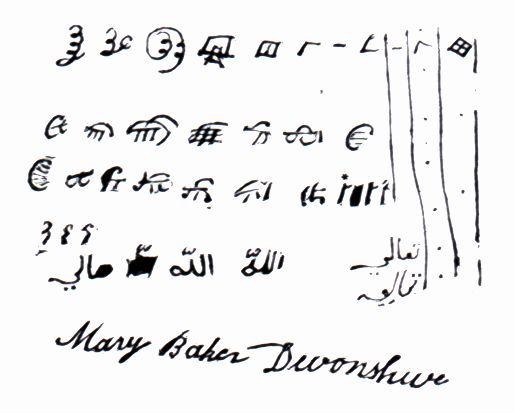
Gibberish characters made use of by Princess Caraboo, via Wikimedia Commons

Gibberish characters made use of by Princess Caraboo, via Wikimedia Commons

Mrs. Worrall checked on her story, of course, and found it corroborated in almost every detail, except for the detail of who the father of her child had been—he may have been a gentleman who married her and swept her away in travel, or he may have been a day laborer or even the husband of one of the families she had served. Regardless, as Mary Baker, aka Princess Caraboo, had never attempted to bilk her or otherwise misuse her outright and had only stayed at the mansion at Mrs. Worrall’s own insistence, she did Baker one last favor and paid her way to America, where this remarkable and resourceful woman disappeared from history and may have actually continued her impostures here. Indeed, who knows what she might have made of herself…

The parallels between Princess Caraboo and Kaspar Hauser are numerous. They both appeared to be innocent creatures in distress and relied on the charity of strangers. Both displayed unusual eating habits, and both inspired legends of having come from royal lineage, legends that they themselves may have encouraged. It is difficult to make the argument that Kaspar Hauser himself had heard the story of Princess Caraboo and decided to perpetrate a similar fraud, although this is entirely possible. What is rather easier to assume is that the general public had heard the story of Princess Caraboo, for a narrative of the incident by John Matthew Gutch, which I have relied on for this account, appeared the very same year in 1817. This famous story of a false foundling, an impostor passing herself off as royalty, may have contributed to the turning of opinion against Kaspar Hauser, for although the theory that he was a lost prince was rising, so too was the notion that he was a sham.

*

Thank you for reading Historical Blindness. I’ll be back in a couple weeks with the conclusion of my series on Kaspar Hauser. If you liked this installment and are interested in historical hoaxes, charlatans and impostors, you’ll love my novel, Manuscript Found!, about the founding of Mormonism. 

Kaspar Hauser, Part One: Foundling

via Artify

via Artify

With this installment, we’ll begin a series exploring one of the most famous historical mysteries, one which gripped all of Europe with speculation and obsession for years and even today brings new fascination and astonishment to those who discover it. The story involves a mysterious character of unknown origins, suspicions of dynastic chicanery, accusations of imposture, and of course, tales of shadowy assassins. This is Kaspar Hauser, Part One: Foundling.

*

Even in the early nineteenth century, legends about wild foundlings were not new. The feral child was a concept that had long captured the interest of the public. Particularly prevalent was the concept of a lost or abandoned child who survived in the wilderness with help of animal benefactors. Tales of human children who were raised by wolves go all the way back to the Middle Ages. In the early 13th century, French chronicler Jacque de Vitry describes a she-wolf stealing and suckling human children and striking them with a paw when they tried to walk upright, teaching them, essentially, the posture of beasts. And in Caesarius of Heisterbach’s Dialogus Miraculorum, we hear of another youth kidnapped away from civilization and fostered by wolves, taught to go about on hands and feet—quadripedally, as it were—while howling wolfishly.

Then the 14th century brought stories of Hessian wolf children. In 1304, tales of a boy snatched from Hesse and living in primeval splendor, laying about the bases and trees and sharing in his wolf pack’s daily catch of game. It is said they ingeniously created crude shelter in winter for the youth, who had no pelt to protect him from the elements. Upon his return to human society, all were quite astonished by the facility with which he leapt and bounded upon all fours, and he proved splendid entertainment in the court of the Hessian prince. Nevertheless, his keepers felt it more seemly that the boy walk erect, which they accomplished by forcibly binding him to a piece of straight wood. The fame of this Wild Boy of Hesse surely colored the motived of hunters some 40 years later, in the Hessian region of Wetterau, when they reportedly discovered another boy who had been living with wolves for 12 years. Again, this feral Hessian child was reintegrated into human society, perhaps more successfully as he lived a recorded 80 years. Indeed these tales of feral children, which may today seem a bit too fabulous to be real, nevertheless inspired Carl Linnaeus, originator of the zoological classification system of binomial nomenclature, to indicate a separate sub-category of humanity designated Homo ferus

And these stories of feral foundlings were fresh in the mind for Europeans in the early nineteenth century. In 1725, a naked, hairy, skittish child of about 12 was discovered in northern Germany, subsisting on grass and leaves in a forest near Hamelin. Unable to speak when he was captured, he was at first kept in a correctional facility before being brought to the court of King George at Herrenhausen as entertainment. He could not stomach bread, and the food he did take—vegetables and rare meat—he devoured messily, with no concept of manners. Thereafter taken to London, he became the toast of the town, serving as the philosophical inspiration of such luminaries as Jonathan Swift and Daniel Defoe and ending up as a kept creature of the Princess of Wales. Given the most respected educators, the Wild Boy of Hamelin, called Peter, made no progress in his letters, causing his tutors eventually to give up their efforts as pointless. Peter was eventually and quite literally put out to pasture, sent to live the rest of his ignominious days as a farmhand. He never learned to speak, but taking a final lesson from civilized people, he did learn to drink gin.

Peter the Wild Boy, via Wikimedia Commons

Peter the Wild Boy, via Wikimedia Commons

These stories of feral children, prominent in the zeitgeist of the 19th century, were not always to be trusted, however. Near the dawn of the 1800s, in southern France, some men exploring a forest found a wild boy who would come to be known as “Victor of Aveyron.” He is described as 11 or 12, his naked body dirty and heavily scarred. Much like Peter, Victor fled when approached but was treed by his pursuers and captured. In a neighboring village, where his captors gave him into the care of a widow, there were reports of having seen the child living in the woods for years. After escaping from the widow’s care, and being recaptured, Victor was sent to Paris to be analyzed as an untainted and pure example of human intellect in its most nascent state. Most doctors who examined him, however, agreed that he was not a feral child but rather a child with cognitive disabilities who had been abandoned by his parents. Indeed, this suggestion appears to offer a convincing explanation for Peter the Wild Boy of Hamelin as well, for modern experts suggest Peter may have suffered from the chromosomal condition known as Pitt-Hopkins syndrome. This idea actually tends to cast doubt on any stories of wild foundlings who showed a lack of intellectual development or failed to respond well to education in that, sadly, they may have been disabled youth callously deserted in the wilderness.

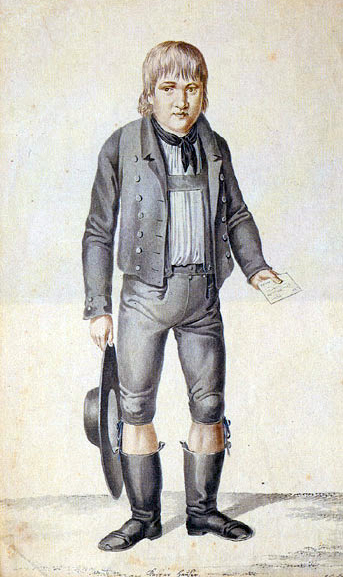
Thus the popularity of wild foundling narratives persisted in the early 19th century, even if it was occasionally dampened by suspicions that the child was not a true savage. It was in this cultural milieu that, on May 26th, 1828, a strange and awkward youth trudged into Nuremburg in what was then the Kingdom of Bavaria. As it was Whitsuntide, a religious holiday commemorating the Pentecost, few people were out roaming the streets, and the tottering figure drew the attention of a shoemaker who stood outside his home enjoying the day. The shoemaker watched as the boy, who looked about 16 years old and seemed healthy enough at a distance, with a strong and thickset frame, came wobbling toward him. Then the shoemaker noticed his unsteady gait, his ragged peasant’s clothes, his boots that were far too small for his feet, and, as the boy came nearer, the blank expression of the blue eyes beneath his wide-brimmed hat.  The boy gave him an uncivilized greeting in an unfamiliar country dialect and indicated abruptly and vaguely his interest in finding New Gate Street. Despite the boy’s simple and broken communication, the kind citizen understood and led him across the Pegnitz River. It was then that the boy, who was clearly struggling to walk in a coordinated manner, produced a sealed envelope from his coat. Examining it, the shoemaker saw that it was addressed rather specifically to the captain of a light horse regiment, prompting the shoemaker to suggest that the boy did not want New Gate Street but rather the New Gate Tower itself, where the guardroom was located. The uncouth boy exclaimed that this tower must be a new structure, to which the shoemaker responded with confusion, for the New Gate was very old indeed. Curious, he asked where the boy had come from and the boy replied that he came from Regensburg. This was to be the only time that this remarkable and enigmatic foundling would ever name a place of origin, and indeed, when the shoemaker asked for news from Regensburg, the boy offered none, as if he knew little of the place from which he came.

Kaspar Hauser, via Wikimedia Commons

Kaspar Hauser, via Wikimedia Commons

The shoemaker returned home once he had seen the boy to guardroom, where the boy removed his wide-brimmed hat and handed the letter to a corporal on duty. The corporal, for his part merely handed the letter back, telling the boy the location of the home of the addressee, the Captain of the Fourth Squadron of the Sixth Regiment of Light Horse. The boy left then, and surprisingly, without any guidance that was recorded, he managed to find his way to the captain’s house, where he gave the letter to a servant and announced in his unsophisticated way that he wanted to be a trooper, like his father before him. He knew not where he had come from, he said now, but it had been a long journey to Nuremberg, during which he had been forced to march ceaselessly. The servant showed him to the stable, where he would be permitted to wait for the captain, and before falling into the deep slumber of true exhaustion, he shared some details about himself with the captain’s man. Upon seeing the horses in the stable, he said, “There were five of those where I was before,” and he told the servant that he had learned his letters in this ambiguous former abode, traveling daily across borderlands to receive schooling. The boy was given beer to drink and meat to sustain him, but this did not please him, for he shrank from the victuals with revulsion. He was indeed extremely hungry and thirsty, but it turned out the only nourishment he could stomach were bread and water.

Eventually, the Captain of the Fourth Squadron arrived and went to the stable to see his visitor. The boy greeted him with delight, reaching out to fondle the shiny ornaments of his uniform and grasping at the sword on his hip, saying innocently, “I want to be such a one!” The captain asked the boy’s name, and the boy said, “I do not know, Your Honor.” Doffing his wide-brimmed hat then, he made reference to a mysterious foster father who had taught him the etiquette of removing his hat in the presence of others, and to address them with the honorific he had used in responding to the captain. The captain took the letter the boy offered and read the following

From the Bavarian Frontier;

        the place is not named.

      1828.

                High well-born Captain!

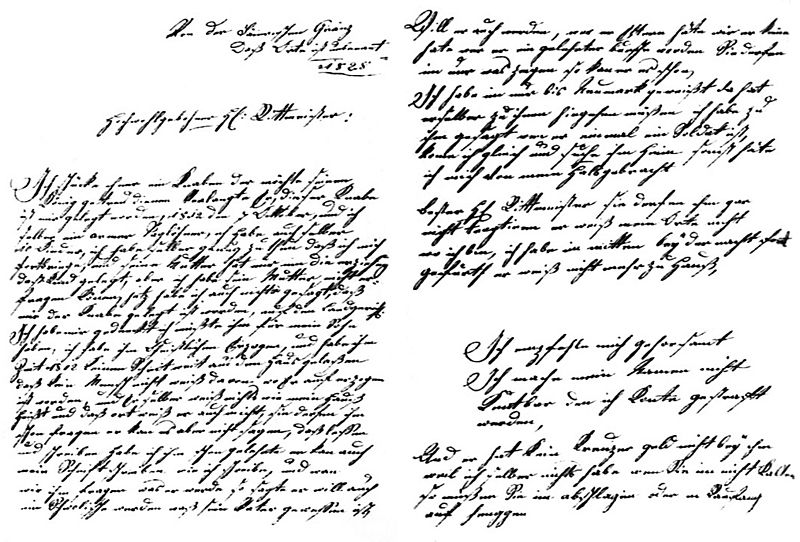
I send to you a boy, who might, as he wishes, serve faithfully the King; the boy was left with me, 1812, the 7th of October, and I am a poor day-labourer, with ten children, and have enough to do to take care of them, and his mother left the child with me to bring him up, but I have not been able to speak to her and I did not mention to the Justice that the child was left with me. I thought that I must consider him as a son, and have brought him up like a Christian; and have not, since 1812, let him go a step from the house, in order that nobody might know where he was brought up, and he himself does not know how my house is called, nor what the place is called; you may ask him, but he cannot mention it. I have already taught him to read and write: he can write my hand-writing like myself; and when we ask him what he will become, he says, he will be a light horseman, as his father was. If he had parents, which he has not, he would have been a learned lad. You need only shew him any thing, he can do it at once.

I have brought him only as far as Neumark, from thence he must go to you. I have said to him, that when he is once a soldier I will come immediately and visit him, otherwise it would cost me my neck.

Best of Captains, you need not trouble him at all, he does not know the place where I am, I brought him away during the night, he does not know the way home.

I am your obedient; I do not make my name known as I could be punished.

And he has not a farthing of money with him, because I have none myself, if you do not keep him, you may kill him, or hang up in the chimney.

Old facsimile of Kaspar's Letter, via Wikimedia Commons

Old facsimile of Kaspar's Letter, via Wikimedia Commons

Enclosed with this letter was a note on a scrap of paper, seemingly written in the same hand and with the same ink but in Latin. This note read: 

The child is already christened, is called Kaspar; you must yourself give him a surname, and bring him up; his father was a light horseman; when he is seventeen years old, send him to Nuremberg, to the 6th regiment of light horse, in which his father also served. I beg you to bring him up till seventeen years old. He was born on the 30th of April, 1812. I am a poor girl; I cannot support the child; his father is dead.

Understandably, the Captain was at a loss as to what he should do with the strange boy named Kaspar. Eventually he decided that it was a police matter and took the child to the police station, where the timid Kaspar was subjected to a rough interrogation. When asked his name, he wrote down “Kaspar Hauser,” which seems like it might have been a name used to mock the boy, if the letter’s indication that he had never been let out of the house is to be believed, as “hauser” could be construed to mean a person who is never allowed outdoors, or a “house-er.” When asked where he was from, Kaspar answered, “I dare not say…because I do not know.” Indeed, he replied to most questions with similar, repetitive answers, pleading ignorance and again reminding everyone that he wanted to follow his father’s footsteps as a soldier. One police officer threatened to abandon him in the woods if he didn’t admit where he was from, and Kaspar panicked and wept like a child: “Not the forest,” he pleaded, “not the forest!” Despite his apparent distress, Kaspar offered them no further insight into his origins, and he was thereafter locked up as a vagrant in the watchtower of the imperial castle.

Before imprisoning him, the police searched his person for some hints to his identity. His trousers appeared designed for riding horses, and his ragged jacket and handkerchief both had been embroidered with the letter “K.” In his pockets, he carried some interesting items: a key, a rosary, a prayer book, some religious tracts…and a small envelope containing a bit of gold dust! So much for the letter’s assurance that searching him would be pointless as he carried no money. And poignantly, considering the narrative offered by the letter and the tale that this “Hauser” was soon to tell, one of the tracts on his person bore the title, “Art of Recovering Lost Time and Ill Spent Years.” 

During his confinement in the tower, physicians examined him, and they determined his facial expression to be remarkably listless, comparing him to a caged and dispirited animal. His hands and feet, they noted, were surpassingly soft, betraying a life of little physical hardship, and indeed, his feet, which had been stuffed into boots far too small for him, were covered in blisters, as if they had gone long unused. Otherwise, he seemed hale enough, strong and well-fed, despite his finicky tastes. He refused to take anything but black bread and water, and this was not pickiness but rather an inability to digest anything else, for when anyone slipped any other fluids into his water—coffee or alcohol—or when they concealed meat inside the bread he ate, Kaspar suffered severe physical reactions: headaches, vomiting and diarrhea. Indeed, when word spread about the Wild Boy being kept in the tower, a great many curious visitors came to meet Kaspar, and some of these were not the kindest of callers. Some, having heard of his timidity and his violent reactions to food, would brandish swords before him and laugh at his fear or slip him food or drink that would disagree with him and delight in his ensuing sickness.

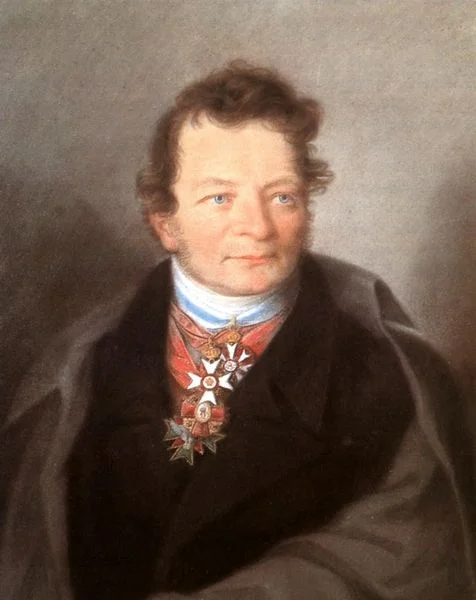
Judge Anselm von Feuerbach, via Wikimedia Commons

Judge Anselm von Feuerbach, via Wikimedia Commons

Others, however, were kind to him, offering him coins and children’s toys, his most prized being a hobby horse. His reaction to these gifts evinced an unusual childishness for his age. He appeared to love anything shiny, and when coins were held out to him and then snatched away, he bawled like an infant. When first his cell had been lit by candle, he reached innocently to touch the flame and recoiled in surprise at the pain of being burned. When presented with his own image in a mirror, like a baby, he reached out to touch the image and circled the looking glass in an attempt to find the child on the other side. These convincing reactions caused many who visited him to believe his story utterly, including the turnkey at the tower, who brought his two-year-old to the tower and watched as Kaspar somewhat ridiculously flinched and withdrew, afraid that the toddler would strike him. Another visitor, Paul Johann Anselm von Feuerbach, a judge of the appeals court, took a great interest in Kaspar after he visited the tower and offered Kaspar two coins, one a shiny coin of lesser value and another a dirty coin of higher value, and was surprised when Kaspar preferred the less valuable one simply because of its luster, even after the Judge explained that it was worth far less. Judge Feuerbach would write a book about Kaspar Hauser that he would publish in 1832, and from the very start, he was certain that the Foundling of Nuremberg was an honest and innocent child, and more than that, as the boy’s vocabulary and ability to communicate grew at leaps and bounds, he began to suspect that Kaspar was a child of great potential and perhaps magnificent origins. When Kaspar finally imparted the story of his origins, the Judge’s suspicions only increased.

Kaspar told of a lifetime of imprisonment in a far smaller cell than he currently enjoyed at the castle tower. The room that was the only world he knew for all his life had been of such small dimensions that most of his years he had spent on his knees or seated. This dungeon had two small windows, but these were kept shuttered or boarded up, so that Kaspar had known only shadow and pitch darkness. The trousers he found himself always wearing had no seat so that he could move his bowels without disrobing, and this he did in a hole in the floor of his miserable cell. His only companions in that place were hobby horses—hence his favor for such toys—and he never saw his captors. Whenever he woke, there was bread and water for him, and occasionally, after noticing his water had a strange taste, he grew drowsy, and upon waking found his nails pared and his clothing changed. This was the nature of his young life, day upon week upon month upon year, until such time as his captor decided he must learn to speak and write and walk like a man. This was somehow, improbably, accomplished in the darkness of his cell by a still unseen jailer who spoke to him until Kaspar could repeat some useful sentences and reached inside to guide Kaspar’s hand in writing his name. Only then had Kaspar been taken outside and taught to take a few wobbly steps before being carted off to Nuremberg and dumped inside the city gates with his letter of introduction.

The story became a sensation in Nuremberg. The very fact that anyone could treat a child so heartlessly, like an animal, created justified outrage, as such terrible tales of child neglect and abuse have tended rightly to do ever since. With the general goodwill of the city extended to him, Kaspar Hauser became an object of pity and love, adopted by Nuremberg as the city’s own child, with many swearing that he would never want for care or comfort. Charitable donations poured in, such that Kaspar Hauser would no longer need to worry about food, clothing, or lodging and would be able to receive a respectable education.

Kaspar's imprisonment, from a contemporary engraving, via LiFo

Kaspar's imprisonment, from a contemporary engraving, via LiFo

Enter Georg Friedrich Daumer, retired schoolmaster. Like so many others, Daumer had taken an interest in Kaspar and offered not only to put up the boy in the house he shared with his mother and sister but also to educate him. Thus a new chapter of Kaspar Hauser’s life began, and Kaspar took up residence with the Daumers. During this new life, he made excellent headway in learning to read and write as well as in his other studies, and true to his love of horses and his dreams of becoming an equestrian, he took easily to horsemanship, a fact that Daumer attributed to his having sat for most of his life, creating a bottom perfect for the saddle.

Daumer, however, was motivated by other interests beyond charity in his stewardship of Kaspar Hauser. Considering himself a man of science, he saw in Kaspar Hauser a perfect opportunity to study  a pure example of humanity, a blank slate of a man who had not yet been corrupted by society, this being a common attraction for those who studied feral children. Indeed, Daumer was interested in the burgeoning alternative medicine system known as homeopathy, which proposed natural, herbal remedies administered in tinctures diluted to such a degree as to seem wholly ineffective. Daumer and an associate homeopath, Dr. Paul Sigmund Preu, performed unending experiments on Kaspar, spiking Kaspar’s water with a variety of herbal concoctions. To their delight, their experiments produced gas, vomit, and diarrhea in their subject, even in extremely diluted form, which they believed to be hard evidence proving the tenets of homeopathy.

Moreover, Daumer and Preu attributed preternatural abilities to Kaspar, claiming that they observed in him the ability to hear and smell at greater distances than most humans and the faculty of seeing even in pitch black darkness. And perhaps the most astonishing of their findings, they claimed that Kaspar was somehow sensitive to magnetic fields, able to find hidden metal objects like a pig sniffing out truffles. Daumer also observed that Kaspar felt some unusual sensations when touching animals and appeared to have some kind of supernatural connection to animals, feeling a kind of sympathetic agitation when animals he was near became distressed or excited. This, Daumer believed, was an example of “animal magnetism,” a concept proposed by mesmerists.

These, of course, seem to be dubious claims, and indeed, when one looks into Daumer’s background, one finds a great deal of eccentricity. Daumer adhered to a variety of pseudo-scientific ideas, including spiritualism and alternative history, some of which was decidedly anti-Semitic. For example, he believed that ancient Jews cannibalized their firstborn in sacrificial rites, and in a less anti-Semitic and more just absurd belief, he traced the path of Jews escaping Egypt all the way across the Asian continent to the New World, suggesting that the parting of the seas was actually a crossing of the Bering Strait, which promptly melted behind them to drown Pharaoh’s armies.

Georg Friedrich Daumer, via Wikimedia Commons

Georg Friedrich Daumer, via Wikimedia Commons

Nevertheless, Daumer did appear to care for Kaspar, for his well-being and education. While under Daumer’s care, much of the city and the world beyond, thinking him well taken care of, lost interest in the story, but not Judge Feuerbach, who had begun to formulate outlandish theories about Kaspar’s origins. The fact that Kaspar showed such a natural predilection toward learning and that, apparently, so much effort had been made to conceal his existence as a child led Feuerbach and many others to hypothesize that Kaspar was actually the descendant of a royal family, and perhaps the heir to a throne, kidnapped and hidden away in order to manipulate a dynasty. Others, however, would point out the inconsistencies in Kaspar’s story to suggest he was a liar and a fraud, for had he not said there were horses where he was from? Had he not been wearing riding breeches? Would not this explain how he took so well to horseback riding? And had he not said that he used to cross borders to go to school? This certainly didn’t jibe with his story of imprisonment in the dark and would certainly help to explain how he was learning so easily, for could he not have simply been pretending to learn things he already knew well?

These are the questions that have lasted from then even until today, when we look back on what we know of Kaspar Hauser and try to come to some conclusion that satisfies. But at this historical distance, we are like a child groping about in the dark, blind to what may be a simple and obvious truth.

*

Thank you for reading Historical Blindness. Join us again in two weeks when we’ll look at another case of a foundling that was taken by many to be royalty, an incredible case of charlatanism and staggering credulity that easily may have colored the public’s perceptions of the Wild Boy of Bavaria. Then we’ll be back in four weeks for the conclusion of this dumbfounding tale: Kaspar Hauser, Part Two—Princeling.

In addition to the work of Judge Anselm von Feuerbach, to which I’ve linked throughout as source material, I am indebted to the work of Dr. Jan Bondeson, whose book, The Great Pretenders: The True Stories behind Famous Historical Mysteries, has been an indispensable resource in composing this installment.

Tell people about the blog! Let them know how much you like it and why you think they’ll like it too. Like us on Facebook and follow us on Twitter, and you can share and retweet our posts there to tell even more people about us. And you can directly support the blog and podcast by purchasing my book, Manuscript Found!, on Amazon, a historical novel about the dubious origins of Mormonism and a Masonic murder mystery that helped shape American party politics.

Until next time... keep your eyes wide...

Blind Spot: The Oberfohren Memorandum and the Ernst Confession

Thank you for reading Historical Blindness. We are now a fortnightly blog, alternating between our full-length installments and shorter bonus posts every two weeks. These Blind Spots serve as companion pieces, telling a separate but similar tale or further exploring the last installment's story by relating an aspect of it we didn’t have time to include. In this Blind Spot, we’ll do the latter, so if you haven’t read the last installment, Firebrand in the Reichstag!, please go back and do so before enjoying this Blind Spot.

*

The story of the Reichstag Fire and the legend of a conspiracy behind it is so far reaching and epic that we did not have time in our already oversized post on the topic to include some of the most interesting passages. Therefore, I proudly present here the stories of two men’s untimely deaths and the disturbing documents that cropped up afterward, linking them to the Reichstag Fire and suggesting a conspiracy to murder and silence them. This is an account of the Oberfohren Memorandum and the Ernst Confession.

Dr. Ernst Oberfohren, via Wikipedia

Dr. Ernst Oberfohren, via Wikipedia

On April 26th, 1933, two months after the burning of the Reichstag and still several months before the publication of the Brown Book and the convening of the farcical London Counter-Trial, the first stirrings of the conspiracy theory that would come to dominate the Reichstag Fire narrative appeared. In a couple articles in an English newspaper, the Manchester Guardian, it was revealed that a manuscript was furtively circulating in Germany, written by a high-ranking official of the Nationalist party, which had until the recent seizure of power been allied with the Nazis, and it purported to tell the true story of the Reichstag arson, suggesting here for the first time in print that the Nazis themselves entered the Reichstag via the underground passage from Göring’s residence, setting the fire to create a Bolshevik scare and thereafter capitalize on the ensuing anarchy to establish a dictatorship. Appearing aghast at such an allegation in the foreign press, the German Legation in London lodged a protest against “so monstrous a vilification,” but soon enough the newspaper’s source surfaced, a memorandum attributed to former parliamentary leader of the German-National People’s Party, Dr. Ernst Oberfohren, recently deceased after an ostensible suicide on May 7th. According to the memorandum’s anonymous introduction, however, Oberfohren’s home had been raided by Brown Shirts, or soldiers of the S.A., the Nazi’s private army, who after finding a copy of the memo, allowed him to commit suicide as the only alternative to a much worse fate.

The Oberfohren Memorandum made a number of accusations, including that, during the raid of the Communist Party headquarters previous to the fire, Brown Shirts had planted guns and documents intended to create the false impression that a workers’ uprising was afoot. When this failed to elicit the uproar they desired, according to the memo, they instead resorted to the arson of the Reichstag. The act was accomplished by Brown Shirts, entering via the tunnel, and leaving behind their “creature,” Marinus van der Lubbe. And in the uproar that ensued, the Nazis planned an armed overthrow of the government in the early days of March that had only just been thwarted by unfavorable circumstances. As can be discerned from the memorandum, Dr. Oberfohren despaired over what the future might hold, and when Hitler’s swastika might usurp the place of the iron cross atop German flagpoles. Thus he had circulated the manuscript, which made its way outside of Germany and presaged the narrative of the Brown Book to come, as well as much historiography for the next three decades.

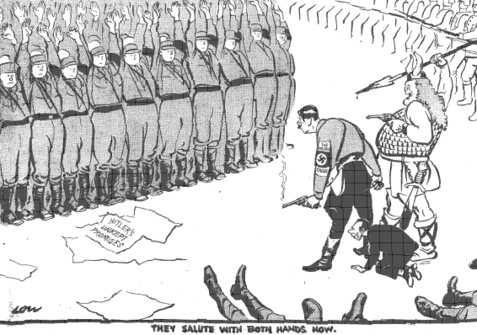
1934 British cartoon satirizing the Night of the Long Knives, via Academic Dictionaries and Encyclopedias

1934 British cartoon satirizing the Night of the Long Knives, via Academic Dictionaries and Encyclopedias

Oberfohren was not alone in having the circumstances surrounding his death questioned and having attributed to him a document that incriminated the Nazis in the Reichstag Fire affair. Around a year after the release of the Oberfohren Memorandum, and half a year after Marinus van der Lubbe had been decapitated for his crime, came the dark and bloody Night of the Long Knives. The popular name for this event hearkens back to the medieval legends of King Arthur, and specifically the murder of unarmed britons by Saxon mercenaries at a banquet in what was called the Treachery of the Long Knives, and indeed the name’s conjuring of violent betrayal is apt, for the Night of the Long Knives, or the Röhm Putsch as Germans know it, was a bloody purge of Hitler’s own private army, the S.A. You see, when Hitler rose to power, he gave a lot of lip service to socialist ideology—hence the National Socialist German Workers’ Party—but having seized power and now aiming for further military domination beyond Germany’s borders, he would need to focus on industry and feared that elements of his Brown Shirt army who had believed his talk of workers’ rights would turn on him and prove to be an impediment. Furthermore, some leaders of the Brown Shirts, including founder Ernst Röhm, his deputy Edmund Heines and Berlin chief Karl Ernst, were known homosexuals—remember that van der Lubbe was depicted in the Brown Book as a homosexual prostitute in service to Röhm—so some among the Nazi leadership, including Göring, found their lifestyle as well as their politics distasteful. These were all reasons enough to turn on some of their staunchest supporters; therefore, on the 30th of June, they launched operation Hummingbird with the force of the other wing of their private army, the S.S. or Black Shirts. That day they arrested and executed numerous Brown Shirt leaders—including Röhm, Heines and Ernst—along with various political figures they deemed problematic, all under the guise of removing immoral elements from their ranks.

Imagine that: a demagogue rouses the downtrodden and resentful to gain power and then promptly betrays their interests. What a surprise…

After the purge, another document surfaced, this one purporting to be a confession penned by recently executed Karl Ernst, in which he admits to conspiring with Nazi and S.A. leaders in firing the Reichstag. Foreseeing the betrayal of Göring and Goebbels, Ernst had written the confession as a safeguard, to keep himself from being assassinated lest it be released upon his death (a gambit that apparently had not succeeded). The Ernst Confession described the entire affair, even from its earliest planning stages, when Göring and Goebbels had felt compelled to scrap a different plan involving a supposedly Communist assassination attempt on Hitler in Breslau. After considering other targets, they settled on the Reichstag, since then they could appear as “champions of parliamentarianism.”  Thinking at first they would hide within until it was empty, they feared being seen and recognized by Communists. According to the confession, it was Ernst himself who came up with the idea of using the underground tunnel, and while inspecting it and hiding their incendiary material, they had almost been caught by the watchman. In this version of events, one of the conspirators had met Marinus van der Lubbe, and thinking him a likely fellow of whom they “should be able to make good use,” convinced him that setting fire to the Reichstag was a grand idea. Thus, as Ernst and the real arsonists were escaping back through the tunnel, having set numerous fires in the Session Chamber, van der Lubbe’s handler was to see him to the Reichstag and ensure he broke into the restaurant to “blunder about conspicuously,” thinking himself the sole arsonist. This is the picture the Ernst Confession paints: calculated manipulation of the political situation, perfect execution of a false flag incident, and utter vindication of the allegations in the Oberfohren Memorandum and the Brown Book.

Karl Ernst, via Wikimedia Commons

Karl Ernst, via Wikimedia Commons

Needless to say, this document did not look good for Hitler and his party, but at this point, the Nazis were beyond redemption in the eyes of the foreign press, and their power in Germany was quickly becoming impossible to challenge. By the end of the summer, President Hindenburg died and Hitler took for himself the position of Führer of Germany, the title meaning vaguely a guide but the role essentially that of a supreme despot. And thenceforth, history marched on in goosestep.

Not until the publication of Fritz Tobias’s groundbreaking work in Der Spiegel did anyone bother to examine the credibility of these documents, the Oberfohren Memorandum and the Ernst Confession. Rather than take them at face value, Tobias attempted to determine the true authors of the documents and to either corroborate or refute their contents. He began by examining the last days of Dr. Oberfohren and his suicide.

As Tobias shows, Oberfohren, a former professor of political science who had taken a position as chairman of the Nationalist deputies in the parliament under party leader Alfred Hugenberg, was increasingly disillusioned with his party, having openly opposed the Nationalists’ decision to give Hitler the chancellorship in an effort to forge a joint majority with the Nazis. Indeed, he had composed some pamphlets attacking Hugenberg and had been found out as the author, resulting in his resignation. Tobias demonstrates that because of his opposition to the Nationalist alliance with the Nazis, he would not have been privy to any secret operations at the time of the fire. Indeed, his suicide appears not to have been compelled by Nazi Storm Troopers but rather precipitated by a combination of emotions: guilt over betraying his party and depression over the direction his country’s government was taking. Visitors during his final days later testified to his hopelessness and, as his own wife put it, his “black despair” over the inevitable rise of a Nazi dictatorship and his powerlessness to oppose it. In fact, his suicide letter is actually addressed to Hugenberg as an apology, describing the “superhuman agonies” he was suffering and bemoaning the damage he had done to the Nationalists.

Thereafter, Tobias addresses the major theses of the memorandum, offering evidence that firearms and revolutionary literature were indeed seized at the Communist headquarters, rather than planted, and that the Nazi coup planned for March was wholly an invention of the real author of the memorandum, Wilhelm Münzenberg, the head of the Communist Agitation and Propaganda department, Agitprop, pointing out reports that forged orders had been circulated days after the fire in an effort to create a scare over a Nazi putsch. These were dismissed as fraudulent and commonly attributed to Münzenberg. Moreover, comparing the writing style of the memorandum to a pamphlet published by the Central Committee of the German Communist Party, Tobias comes to the conclusion that the Oberfohren Memorandum was also written by Münzenberg and later simply repurposed as a forgery thereafter attributed to Oberfohren following his suicide.

Propagandist Willi Münzenberg, via Wikimedia Commons

Propagandist Willi Münzenberg, via Wikimedia Commons

Likewise, Fritz Tobias casts doubt on the idea that Karl Ernst and others were executed on the Night of the Long Knives in order to eliminate loose ends and further cover up Nazi responsibility for the fire. Rather, he presents the more likely scenario that Ernst and his fellow Brown Shirt Storm Troopers were executed for all the obvious reasons: their political differences and the threat they posed to the National Socialist agenda. Then, as before, Willi Münzenberg seized on the opportunity to attribute a forgery to the fresh corpses that the Nazis had left in their wake. He points out that the two men named in the confession as accomplices in setting the fire had, embarrassingly, actually survived the S.A. purge and, with no reason to remain loyal to the Nazis, called the confession a fraud. And later, some of Münzenberg’s own fellow Communists named the “so-called Ernst testament” as an outright concoction edited by none other than Marinus van der Lubbe’s co-defendant, Georgi Dimitrov, the Communist leader lately acquitted of having had any part in the burning of the Reichstag.

In a world of political narratives handled so craftily by masters of public perception, our understanding of the past is not a matter of flat fact and hard documentation easily recalled. History was unreliable enough when it was written by the victors, but as can be seen in this story, now it can also be written by spin doctors, and the spotlight of truth can be purposely obscured by forgers and propagandists, leaving instead only blind spots.

*

Thanks for reading Historical Blindness. Review the podcast on iTunes if you can. Poke around the website to donate, read our blog entries and find links to our social media accounts and to my book on Amazon. And keep an eye out for our next full length episode, which will take you back to Germany, although about a century earlier…

Until next time... keep your eyes wide....

Firebrand in the Reichstag!

In this installment of Historical Blindness, we will delve into a topic that, although largely settled among respected historians, remains a living legend in the public mind, with most lay persons still believing long disproven lies to be true. This is a subject, it must be said, that still, some eighty years on, inspires passion and heated argument. As such, I feel I must make my intentions clear in a preemptive apology of sorts, offering assurances regarding my motives in undertaking to tell this story. In presenting the various narratives of this event, several of which have been propagated since it transpired, I do not intend to exonerate any one party, nor do I have any desire to present the Nazis, who feature prominently in the story, as anything other than the great villains of their era. Many before me have investigated this topic, and in making certain observations regarding culpability for this specific event, have been accused of trying to exonerate Hitler’s fascist regime and whitewash their crimes. Indeed, current day neo-nazis and white nationalists frequently tout some of the admirable historiography I will rely on here in their repugnant apologism of Nazi racism and their denial of the genocide that Hitler perpetrated. I must, therefore, make it absolutely clear at the outset that Hitler and his fascist National Socialist German Workers’ Party, aka the Nazis, can never be acquitted for the many monstrous crimes they committed against humanity and the ideals of freedom and equality. A search for truth among purposeful fabrications in the historical record may find that one specific crime traditionally laid at their feet may not have been perpetrated by them, but nevertheless, their reaction to said crime and the many subsequent offences committed by them, which cannot be denied, remain to damn Hitler and his Nazis forever.

But I get ahead of myself… To make a beginning, we must look further back, to the rise of Hitler and his Nazis, and to the volatile conditions of the Weimar Republic, crippled by the Great Depression and by insurmountable political division, which created a tinderbox awaiting a spark. This was the Weimar Republic in its death throes: a society gripped by an unemployment rate of almost 40%, a government that could not rule except by emergency decree and continual dissolution of a deadlocked legislature, and a very dangerous fascist newly installed as chancellor seeking to eliminate the political obstacle represented by the opposition Communist Party. The Nazi conflict with Berlin Communists had just culminated in the Communist Party headquarters, the Karl Liebknecht House, being raided, their firearm stockpiles seized, by the Berlin Police, the chief of which also happened to be a leader of the S.A., or Brownshirts, the paramilitary wing of the Nazi Party. It was in this combustible atmosphere that, just after 9pm on February 27, 1933, the conflagration began.

The night was remarkably cold, 22 degrees Fahrenheit with an icy wind that blasted through the streets of Berlin, cutting through one’s overcoat to chill the bones. This wintry gale blew hard on the façade of the Reichstag, the grand edifice of German republicanism that had housed various legislative bodies and stood, with its ornate Neo-Baroque columns and impressive glass and steel cupola, for nearly forty years. The Reichstag was empty at this time of night: the last government official departed for the evening, the postman come and gone, the night watchman done with his rounds. Nevertheless, the streets around the Reichstag were not deserted completely; various passersby were still about, hurrying home through the cold or enjoying a bracing winter’s walk arm in arm with a spouse. One of these, a student come from the library and passing near the front of the Reichstag, heard breaking glass and, turning, saw a figure on a first-floor balcony with what appeared to be a flaming object in hand. The student immediately sought out a policeman who was walking his beat on the opposite side of the Reichstag; he pointed the officer in the direction of the figure he’d seen, slapping his back and insisting he investigate.

The Reichstag before the fire, from The Reichstag Fire by Fritz Tobias.

The Reichstag before the fire, from The Reichstag Fire by Fritz Tobias.

Upon reaching the spot the student had indicated, the officer, a sergeant, saw a broken window and observed a reddish glow within the building. Another passerby joined him to gawp silently, and then a third, a typesetter who had heard the glass breaking, thought he’d seen two men entering the building and tried to raise the alarm on the southern side of the Reichstag with a blind cry into the night that may not have even been heard. Having returned to find the sergeant and the other passerby, he joined them in staring at what was the restaurant on the first floor, seeing a figure inside passing before several windows, torch blazing in hand. They followed his progress. The sergeant drew his gun. The typesetter bellowed, “…why don’t you fire?” and the sergeant did, discharging his gun toward a window where the intruder could be seen and only succeeding in driving the firebug farther into the Reichstag’s interior. Only then did the police sergeant think to send passersby to raise the police and the fire brigade.

What ensued was a comedy of errors, with people running in all different directions: to a police precinct, shouting for help; to an engineering institute, pleading for the caretaker to telephone the fire brigade; and to the lodge of the doorkeeper of the Reichstag, demanding he activate the fire alarm. In response, the 32nd precinct scrambled a squad car but brought no reinforcements, the caretaker of the engineering institute fumbled with a phone book but failed to find the fire brigade’s number, and the Reichstag doorkeeper scoffed, refusing to believe the building was on fire until he went to see for himself. And when police finally tried to enter and do something about the matter, they found door after door barred. The doorkeeper, finally convinced of the emergency, was able to admit them by the north entrance, but they had to wait ineffectually for the House-Inspector to arrive with keys to the inner doors. The doorkeeper, in his panic, had not phoned the House-Inspector but rather the Chief Reichstag Messenger, who had activated the phone tree with the news. Luckily, the House-Inspector had heard fire engines while tucking into his supper, had called the doorkeeper himself, and was on his way, angry at not being called directly. Eventually, some 15 minutes after the arsonist’s entrance into the building, the police were able to gain entry as well.

The House-Inspector, a Lieutenant of the 32nd Precinct, and a few constables climbed the stairs, crossed the lobby and were met with the eerie sight of red light emanating from behind a monument to Kaiser Wilhelm. The curtains framing a door to the main Session Chamber were blazing, and through the glass door, more fire could be glimpsed.  Upon entering the Session Chamber, they witnessed a sheet of fire rising behind the tribune and the Speaker’s Chair at the back of the chamber, as well as below, in the stenographer’s well. It looked to them like a brightly glowing church organ.

The House-Inspector also claimed to have seen numerous small, sputtering fires among the deputies’ benches on either side of the tribune. Firemen had meanwhile arrived, fighting a number of small fires in other lobbies, so the House-Inspector shut the doors and left with a constable to search out the arsonist. One of the firemen thereafter opened the door again and, struck by smoke and heat upon entering the Session Chamber and marking a great draft through the doors, thought it best to close the room off. But of course, the chamber was not truly shut off, for the great glass dome above had been breached by the fire, acting as a chimney and making of the chamber a furnace. Before long, the Reichstag’s Session Chamber would be absolutely cored out of the building.

The burnt-out Sessions Chamber, from The Reichstag Fire by Fritz Tobias.

The burnt-out Sessions Chamber, from The Reichstag Fire by Fritz Tobias.

The House-Inspector and the constable did not search long before, as they passed beneath a grand chandelier in the southern corridor of Bismarck Hall, a tall and bare-chested young man darted in front of them, coming from the direction of the rear of the Session Chamber. Upon seeing them, he froze a moment before trying to flee back from whence he had come. When the constable trained his pistol on the figure and called for him to raise his hands, the young man stopped and complied, heaving for breath. Searching his trousers, the constable found a passport with his name: Marinus van der Lubbe.

“Why did you do it?” the House-Inspector demanded, trembling in a fury.

“As a protest,” van der Lubbe said mildly, and the House-Inspector struck him.

Marinus van der Lubbe was taken away to endure an arduous interrogation, and by 11pm, the fire he had apparently set was extinguished, leaving only a charred black cavity at the heart of the Reichstag, where the Session Chamber had been. No one else was arrested on the scene, and indeed, no other suspects had been witnessed. Although the typesetter who witnessed someone breaking in thought at first he had seen two figures, it eventually seemed more likely to investigators that the second figure had been a reflection. And though there was subsequent report of a shadowy figure seen leaving the southern entrance of the Reichstag at about the same time as the window was being broken, receiving some sort of gestural signal from two women across the street and then fleeing, though not without a suspicious backward glance at the building, later this shadowy agent was determined to have been an innocent passerby taking shelter from the wind and then running off to catch a bus. And with Marinus van der Lubbe’s confession, which he gave gladly, in addition to his subsequent walkthrough of the Reichstag to show authorities how he had set the fire quite by himself, it appeared that the case was closed and the state had their man.

Marinus van der Lubbe, from The Reichstag Fire by Fritz Tobias.

Marinus van der Lubbe, from The Reichstag Fire by Fritz Tobias.

But of course, if you have ever heard of the Reichstag Fire, you know it was not that simple. The event has become a pivotal moment in modern history, and in public perception, it has come to serve as a symbol for conspiracy and manipulation. It is looked at and referred to as the prototypical example of a “false flag” operation, or a covert operation executing some incident with the intention to deceive the world into believing said incident was perpetrated by some nation or group that in fact bears no responsibility for it. The Reichstag Fire has become the quintessential false flag operation, and has been used ever since in American political discourse to draw parallels and cast aspersions, fueling conspiracy theories from one extreme of the political spectrum to the other. After the attacks of September 11th, 2001, when the Bush administration declared a nebulous and unilateral War on Terror and whittled down civil rights with the Patriot Act, critics cried that 9/11 was his Reichstag Fire. When the tragic mass shootings of 2012 prompted an urgent national discussion of mental illness and gun violence, some conspiracy theorists callously suggested these events were staged by the Obama administration as part of a plan to declare martial law and disarm the populace, the idea being that they would be his Reichstag Fire, justifying the taking of our guns. Even leading up to the recent election of Donald Trump, some feared an imminent Reichstag Fire event that would allow Obama to extend his time in power or somehow rig the election against the Trumpites. And now, in the Age of Trump, fueled by genuine fearmongering from an administration that tells us any checks on its power, any obstruction of its agenda will result directly in terror attacks, anxiety over a looming Reichstag Fire runs high. Even as I prepared this episode, a recent and horrifying chemical attack in Syria is suspected to be a false flag intended to trigger—or justify—American military action against the current Syrian regime, which Trump promptly and literally launched.

With so much meaning imbued in this event, it behooves us to examine it more closely as a “false flag.” Accusations that a conspiracy was afoot began almost immediately, as the Speaker of the Reichstag, Hermann Göring, whose residence stood across the street, straightaway formulated the opinion that the fire was the work of the embattled Communists and specifically the leader of the Communist Party in the Reichstag, Ernst Torgler. And even as the building burned, then-chancellor Adolph Hitler arrived at the scene, and on a balcony overlooking the conflagration inside the Session Chamber, lit by the glow of the fire and red-faced from the heat and from fury, is said to have remarked that it was the beginning of a Communist uprising. “Now we’ll show them!” he is said to have shouted. “Anyone who stands in our way will be mown down. The German people have been soft too long. Every Communist official must be shot. All Communist deputies must be hanged this very night. All friends of the Communists must be locked up.” And indeed, the night of the fire, the Berlin police and the Brownshirts were quite busy, kicking down the doors of thousands of Communists to drag them out of their beds and incarcerate them. Before long, the Nazis had charged four others for the firing of the Reichstag: Communist leader Ernst Torgler, who had been in the Reichstag late that night, and three little-known Bulgarian Communists, Georgi Dimitrov, Blagoi Popov and Vassili Tanev.

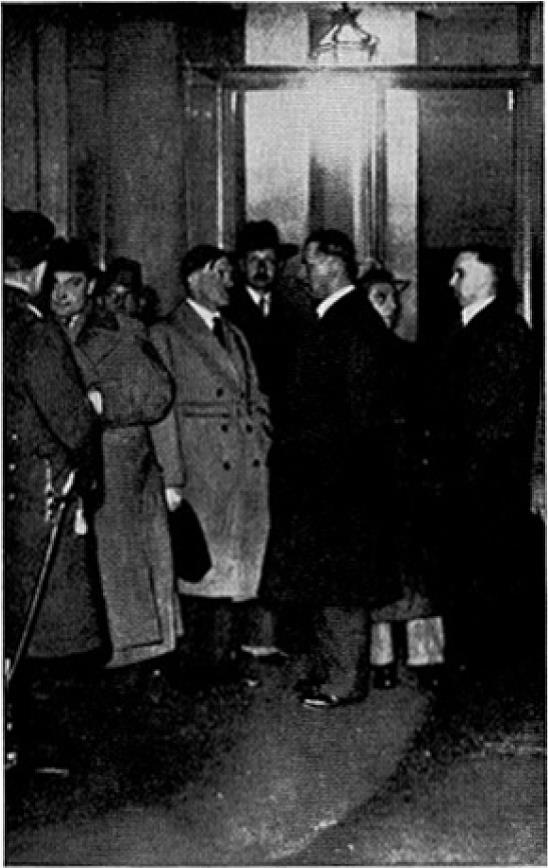
The Nazi leaders at the scene of the fire. Hitler talking to Prince August Wilhelm, Göring (second from left) and Goebbels (second from right), from The Reichstag Fire by Fritz Tobias.

The Nazi leaders at the scene of the fire. Hitler talking to Prince August Wilhelm, Göring (second from left) and Goebbels (second from right), from The Reichstag Fire by Fritz Tobias.

Almost simultaneously, the Communists of Berlin and beyond, as well as much of the foreign press, deemed it more believable to lay the blame for the fire at the feet of the Nazis themselves, a true false flag operation intended to make all of Germany fear a Communist uprising and provide pretext for the Nazis to declare martial law and bolster their governmental power. And indeed, the passage of the ominously named Enabling Laws, and most importantly the “Decree for the Protection of the People and the State,” soon gave credence to this suspicion.

On one item, at least, both sides of this argument could agree: Marinus van der Lubbe could not possibly have managed to set the Reichstag ablaze all by himself. Just based on common sense, almost everyone decided that he was either a madman or an imbecile, and details of the investigation that thereafter emerged only encouraged this assumption: an early communique relating the results of the police report indicated “that the incendiary material could not have been carried in by less than seven persons, and that the distribution and simultaneous lighting of the several fires in the gigantic building required the presence of at least ten persons.” The question, then, was who were the others, and which side had masterminded the act?

Communists abroad had no intention of waiting for the ruling of the German Supreme Court, which anyway they were certain they could guess. In solidarity with the defendants, then, who aside from van der Lubbe were widely regarded as innocent scapegoats, a book entitled The Brown Book of the Hitler Terror and the Burning of the Reichstag was published and a symbolic counter-trial was organized in London, with a variety of well-respected lawyers involved and various noteworthy intellectuals in attendance, including H. G. Wells.

The Brown Book and witnesses at the counter-trial took the low estimation of van der Lubbe’s character and ran with it, relying on a variety of never before cited sources to implicate the firebug as a homosexual prostitute and familiar of Brownshirt leader Ernst Röhm. The book also uncovered the fact that a tunnel existed beneath the home of Speaker Hermann Göring, crossing beneath the street and offering the likeliest means by which Nazi arsonists could have entered and exited the Reichstag undetected. Thus, the true incendiaries had escaped unseen and left behind their patsy, Marinus van der Lubbe, erstwhile Communist, perhaps, but in truth a Nazi stooge. This Brown Book, which was written anonymously but popularly attributed to none other than Albert Einstein, who always denied authoring it, presented a narrative of the fire that persisted for many years to come, such that many history textbooks reported as fact that Hitler certainly arranged the burning of the Reichstag himself, and even today many will repeat this story as accepted fact.

British Newsreel describing London Counter-Trial and German Supreme Court trial in Leipzig, via YouTube

After the counter-trial, the whole world, having witnessed the consolidation of Nazi power and the ruthless grinding out of Communist resistance in the wake of the fire, waited with bated breath for the outcome of the trial. But to the surprise of most, reports from the Supreme Court in Berlin indicated that the defendants were receiving a rather earnest defense and fair trial. Unusually, the proceedings found themselves bogged down in somewhat extraneous matters, as the prosecution, rather than just focusing on proving the defendants’ guilt, endeavored instead to defend the Nazis from the accusations of the Brown Book. When the trial did focus on the charges at hand, the issue under examination was whether van der Lubbe had any concrete association with the Communist Party leadership and fellow defendant Torgler in particular, which according to the court’s opinion the prosecutors failed to prove. The prosecution then had more than they bargained for when the Bulgarian defendant Dimitrov, who unbeknownst to them happened to be a high-ranking representative of the Communist International, took the stand. With sharp wit and clever logic, he turned every accusation back at the Nazis, holding up a figurative mirror so that every implied wrongdoing, every allegation of conspiracy and furtive crime became a fresh charge they had to defend against themselves. And while they succeeded with their parade of experts, who were in fact chemistry professors and criminologists with no practical expertise in fire assessment, to convince the court that van der Lubbe could not have acted alone, they failed to offer enough evidence to convict German Communist Party leader Torgler, international Communist leader Dimitrov or the other two Bulgarian defendants. Marinus van der Lubbe, however, who had stringently denied having accomplices throughout the proceedings and seemed to sink into black despair as the consequences of his actions unfolded, was convicted, and under a newly passed law that called for capital punishment in cases of high treason and arson, purposely made retroactive to apply to the Reichstag Fire case, he was beheaded within the year.

With the Supreme Court ruling that van der Lubbe did indeed have accomplices, the Nazis were at least able to maintain their insistence that their rule had been necessitated by the Red Peril. Meanwhile, the rest of the world—and, for the most part, historians—would side with the Communists and remain convinced that the Nazis themselves were the shadowy accomplices, and, ironically, their own tribunal, called on to condemn their enemies, had only served to prove the suspicions against themselves.

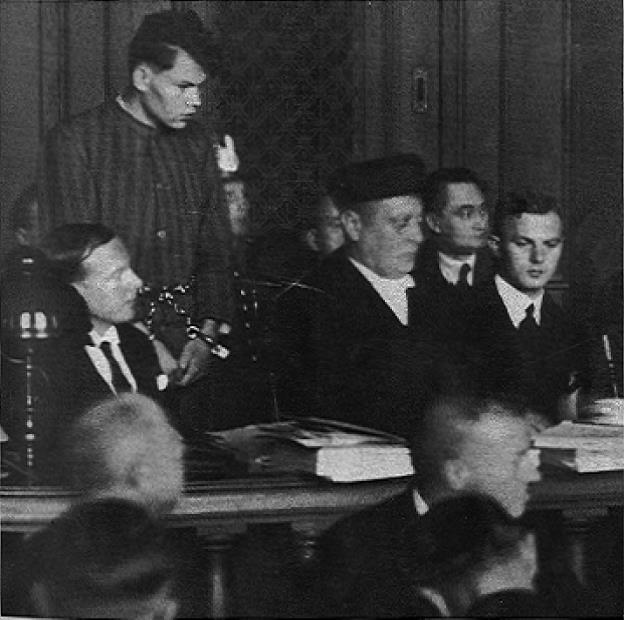
Marinus van der Lubbe at his trial, from The Reichstag Fire by Fritz Tobias.

Marinus van der Lubbe at his trial, from The Reichstag Fire by Fritz Tobias.

Indeed, the ironies abound in this story, for not quite thirty years after the fire, an outsider to the world of academic history named Fritz Tobias, giving a sober and balanced look at all surviving documents, would prove to the world that Marinus van der Lubbe was indeed the sole arsonist, and his reckless act of political indignation, meant to wake up the common people to fight against the Nazi “mercenaries of capitalism,” had indeed ushered in the horrors of the Third Reich. Tobias’s work, which appeared in the German publication Der Spiegel in 1959 and which later he published under the title The Reichstag Fire: Legend and Reality, is a seminal work that changed history even if it failed to completely alter the public imagination when it comes to the fire, and I have relied on its remarkable details heavily in this account. Unfortunately, just as Tobias was attacked at the time as a whitewasher of Nazi history, in modern times his work has been embraced by Nazi apologists and holocaust deniers as proof the Nazis weren’t so bad. Because of that, while his work is available in its entirety in the form of a PDF online, the file appears to only be hosted by white nationalist websites spreading despicably racist ideology. Therefore, I have decided to host the file on my own website in an effort to make it available while also divorcing it from such associations.

In his work, Tobias systematically dismantles the prevailing narratives of not only the Nazi theory of Communist culpability but, more importantly considering its widespread acceptance, the Communist theory of Nazi culpability. He goes into minute detail describing the night of the fire, showing how the night watchman and others, like the Reichstag postman, had walked through the building minutes before witnesses saw van der Lubbe breaking in and had seen no one, smelled no petroleum or smoke. He demonstrates the fundamental unlikelihood that anyone entered the Reichstag via the underground passage because it was a labyrinth of locked doors and steam pipes with a floor of loose metal plates that made such a clamor when someone walked on them that the night watchman surely would have heard anyone passing through it. He examines van der Lubbe’s life, relying on the testimony of those who actually knew him and dissecting the testimony of those who didn’t to show he was no homosexual, no madman, no imbecile, but rather an intelligent young man, disgruntled due to unemployment, who not only was capable of setting the fire exactly how he said he had done it but who also had set fire, all by himself, to a number of other public buildings in the preceding days: a welfare office, the Town Hall and the old Imperial Palace. Moreover, he provides evidence that the early communique’s estimation of seven to ten arsonists was not based on any evidence but rather made on Göring’s insistence, for political reasons, and he debunks the testimony of the so-called experts at the official trial to establish that van der Lubbe not only could have started the fire himself but that he absolutely did. Furthermore, he reveals the true mind behind the Brown Book and the London counter-trial to be none other than Wilhelm Münzenberg, the head of Agitprop, or the Communist Agitation and Propaganda Department, in Paris. Indeed, Tobias goes through every charge in the Brown Book, showing it to be an outrageous tissue of lies and forgeries invented not only to indict Nazis for starting the fire but also to further the Communist cause. And he reveals the counter-trial to be a farce, with comical language barriers, Communist agitators pretending at unbiased judgment, bored officials checking out girls and even one witness who actually wore a mask on the stand in order to pretend to be a Storm Trooper with inside knowledge of the arson, when in fact he was a Jewish journalist.

Predictably, Tobias was condemned for defending the Nazis, but with time and considered reflection on his work, the historical community at large realized that his was the most measured, realistic and convincing account of the Reichstag fire. Other historians, both professional and amateur, have since tried to resuscitate the theory of Nazi culpability for the fire, including most recently a book by Benjamin Carter Hett in 2014, but none of their attempts have succeeded in supplanting Tobias’s version of events in academic circles as they appear to rely solely on rehashing old speculation and second-guessing the credibility of Tobias and his sources rather than offering actual evidence.

In 2008, Marinus van der Lubbe was posthumously exonerated, but this was a purely symbolic gesture not reflective of his actual guilt in the crime. It was meant more to represent the modern sentiment that any criminal convictions made under the auspices of National Socialism must not have been an expression of justice, as Nazism itself represented the antithesis of justice. And still there are many who believe that we should not dare suggest the Nazis were innocent of any particular offense among their litany of crimes. In truth, acquitting the Nazis of this specific crime in no way excuses their manipulation of the event as an opportunity to seize power. Indeed, one can certainly imagine them perpetrating such a crime. Take for example their attack on the radio station at Gleiwitz in 1939, which many consider a false flag as it was meant to be blamed on Polish troops, and to ensure this, they are said to have taken concentration camp prisoners, murdered them with injections, dressed them in Polish uniforms and left them on the scene (although this too is disputed). The fact that they failed to plant such brazen evidence at the Reichstag, that they appeared by all reports shocked and angry upon learning of the fire and that they then put their supposed suspects on trial rather than summarily executing them to control the narrative of their hoax all tends to show that they weren’t responsible for the arson. But the fact that Hitler seized on the opportunity with such gleeful alacrity, calling it a signal from heaven,” should serve as an even darker lesson to which we should never turn a blind eye. Whether or not events have been orchestrated in conspiracy, how a government reacts to them, how they use them to their own advantage to promulgate doctrines or advance agendas, must always be closely scrutinized. We cannot afford to wear blinders when it comes to our leaders’ machinations. We might not survive such a bout of historical blindness.

*

Thanks for reading Historical Blindness blog. Be sure listen to this episode of the Odd Past Podcast. Download numbers really help. If you enjoy the show and are fascinated by historical mysteries, check out my novel, Manuscript Found!. Just visit the Books page of the website for links to the book on Amazon, where it’s available in paperback and on the Kindle for a meager sum. The first of a trilogy that is mostly complete, this volume is a gripping yarn about a Masonic murder mystery and one of the grandest hoaxes ever perpetrated: the beginning of the Mormon Church. As always, you can support us by subscribing if you haven’t already, liking us on Facebook and following us on Twitter (where my username is @historicalblind), by telling friends and family about the show and by donating if you feel generous. On the Donate page of the website, you can give a one-time donation or find a link to our Patreon page where you can pledge a monthly amount. Either way you’ll get a shout out on the podcast! Thanks again for reading the Historical Blindness blog.       

Blind Spot: The Codex of Rohonc

A facsimile edition of the Rohonc Codex, via Wikimedia Commons

A facsimile edition of the Rohonc Codex, via Wikimedia Commons

Thank you for reading Historical Blindness. This is the debut of a new interstitial series: Blind Spots. The principal installments of Historical Blindness require quite a bit of work on my part, including research, composition, and formatting each blog post as well as recording, editing and mixing the podcast, all of which I have to find time to do myself. As such, the project has settled into an already somewhat hectic monthly release schedule. I understand, however, that readers like to see new installments show up in their feeds far more frequently than this. Therefore, in an effort to please existing fans and perhaps find a wider audience, I am now endeavoring to fill the barren time span between the primary posts with these shorter Blind Spots, in which I intend to further explore the most recent story I covered or briefly relate a somewhat peripheral story.

With this purpose in mind, recall our last installment, which opened the mysterious Voynich Manuscript for your perusal. Wilfrid Voynich’s manuscript is not, however, alone in its inscrutability and mystique. Consider another mysterious antiquarian manuscript, unreadable and resistant to all attempts at translation or decipherment since it turned up nearly two hundred years ago. This mysterious tome: the Codex of Rohonc.

***

All his life, Gusztáv Batthyány had lived in England as a count, breeding racehorses and enjoying a life of wealth and leisure. Nevertheless, his heritage as a Hungarian nobleman was an important part of his identity, and when his homeland erupted in revolution, one of many across Europe during the tumultuous year of 1848, sometimes called the Spring of Nations or the Springtime of the Peoples, Batthyány proved his devotion to Hungary more than mere lip service, acting on behalf of Magyar nationalists on a constitutional ministry during a time when his family member, Lajos Batthyány, became the first Hungarian Prime Minister. While Lajos was executed by firing squad a year later, Gusztáv survived his involvement in the political upheaval and lived out his years in comfort in his English home, enjoying fine food, drink and horse races until the day his heart gave out in 1883.

An 1883 portrait of Batthyány, via Wikimedia Commons

An 1883 portrait of Batthyány, via Wikimedia Commons

Today, what Batthyány is more often remembered for is his part in bringing the so-called Rohonc Codex to light. In 1838, he donated an extensive library from Rohonc [ˈrohont͡s], a village in Burgenland where his family owned much land, to the Hungarian Academy of Sciences. Some records seem to indicate that the Codex of Rohonc was at the library as far back as 1743, when it was identified in catalogues as a prayer book despite the fact that it couldn’t have been read to determine such a thing. Agents of the academy very quickly observed that the book was an item of interest. Leather-bound and 448 pages, the manuscript contained a variety of antiquarian-seeming religious illustrations and much writing of an unrecognizable character. Moreover, there appeared to be a watermark of an anchor with a star that led one scholar to eventually conclude the paper originated from 16th century Italy. One of the agents of the Academy of Sciences believed, upon first laying eyes on it, that the script resembled runic Hungarian, and this correlated well with another recent find, the wooden book of Túróc, which was making news in that it seemed to hint at a grander Hungarian history than was contemporaneously known. If the Rohonc Codex also proved to be an important relic of Hungary’s past, it would be a major find. Thus the earnest study of the Rohonc Codex began.

The book was found to contain much Christian iconography, but additionally, some illustrations depicting astronomical symbols, such as stars, suns and crescent moons, have hinted at pagan or even Islamic iconography, which some have theorized indicates the book comes from an unusually cosmopolitan society or originates from a syncretistic religious tradition. And the system of writing turned out to be no less mystifying than the illustrations. While some characters appear rune-like, as first surmised, others seem rounded and not runic at all. Various linguists have thought the script to be Greek, Cyrillic, or even an alphabet originating from an obscure ancient region of the Roman era called Dacia. One subsequently criticized theorist claimed to recognize the writing as Indian Brahmic and hazarded a subsequently discredited translation. Moreover, the number of distinct characters alone made translation impossible, as there appear to be at least 200 individual graphemes, suggesting that rather than a code or language, it may be written using a syllabary, which provides characters not for letters but for combinations of letters into sounds and syllables.

Page 41 of the Rohonc Codex, via Wikimedia Commons

Page 41 of the Rohonc Codex, via Wikimedia Commons

Scholars continued their studies of the codex for years, certain that if they could decipher the text, the manuscript would offer some historical insights heretofore undiscovered, or at least that it would prove to be an artifact of some worth. Then, in 1866, it was revealed that the wooden book of Túróc, with which the Rohonc Codex had been so favorably compared, was in fact a forgery perpetrated by one Sámuel Literáti Nemes. A Hungarian antiquarian of some renown, universally respected as the discoverer of the Massman Tablets, which at the time were the sole surviving Roman writing tablets known to be in existence, Nemes sold rare old books, coins and artwork to Hungarian aristocrats out of his “Old Curiosity Shop” beneath the towering skeleton of a mammoth. The revelation that Nemes, a Hungarian nationalist, had forged the wooden book of Túróc and other items in an effort to provide some impressive monuments of Hungarian history, shocked many. And this scandal stained the reputation of the Rohonc Codex, as many scholars then studying the manuscript dismissed it as another forgery by the Hungarian hoaxer.

Since that time, however, academic interest in the Codex has again resurged. One scholar working on translating the codex, Benedek Láng, is convinced that it is no forgery. He argues that it is not mentioned in any of Nemes’s papers, as his other forgeries are; it doesn’t conform to the format and presentation of his other forgeries, which were all clearly intended to be taken as old Hungarian; and it is far longer than his other forgeries—indeed, longer even than might have been necessary to fool Nemes’s patrons. Láng also takes issue with the idea that the Rohonc Codex is a Nemes forgery based on the fact that the usual motivation isn’t there. Forgeries, he says, are usually perpetrated to make money, to manipulate the historical view of the past, or to play a practical joke, but the Rohonc Codex, its content indecipherable and therefore not useful in rewriting history or otherwise pranking readers or swindling buyers, seems to have been written for intellectual purposes, which doesn’t correspond with Nemes’s modus operandi. In his own studies, Benedek Láng has come to the conclusion that there is some authentic meaning in the text, but rather than an unrecognized ancient language, he theorizes that it must be “…a cipher, …a shorthand system, or …an artificial language.”

Page 44 of the Rohonc Codex, via Wikimedia Commons

Page 44 of the Rohonc Codex, via Wikimedia Commons

Yet still, the Rohonc Codex remains, at least for now, a mystery. Moreover, researching the scholarship on the manuscript is made extraordinarily difficult for anyone who doesn’t speak Hungarian or have access to a library of works written in that language. Aside from a couple of sources I’ve linked, most of the information available online is published on websiteslike Historic Mysteries and blogs like Passing Strangeness, and The Codex from Rohonc Project, and most of these seem to have taken much of their information from the Wikipedia entry or from obscure books, like Némethi Kálmán’s 1892 Rohonczi Codex Tantétel, which apparently is not available online (at least not in translation!). Thus all we have, at least until some major breakthrough becomes public, are the much repeated details that have long been known, as well as, of course, our speculations. And this is commonplace when browsing through history and peering into the darkness of its blind spots.

***

Thanks for reading Historical Blindness, the Odd Past Podcast. We’ll have a full length post for you hopefully within a couple weeks, so subscribe to our RSS feed if you haven’t already, like us on Facebook and follow us on Twitter, where my username is @historicalblind. If you enjoy the show and are fascinated by historical hoaxes, check out my novel, Manuscript Found! on Amazon, available in paperback and on the Kindle for a meager sum. The first of a trilogy that is mostly complete, this volume is a gripping yarn about one of the grandest hoaxes ever perpetrated: the beginning of the Mormon Church.